Saurabh Lahoti is the founder of GTMDialogues, helping early-stage B2B startups scale with sharper GTM strategy, inbound marketing, and founder-led storytelling.
In August 2026, Pocket's founder posted a number that made hardware investors do a double take. One million dollars to one hundred million dollars in annualized recurring revenue in seven months, with over 270,000 devices already in the hands of users. By the company's own account, that makes it the fastest hardware startup in Y Combinator's history to cross nine figures of ARR.
Hardware companies are supposed to move slowly. Tooling, inventory, shipping, and support all add friction that software companies never have to deal with. Pocket built a business where nearly every decision downstream of the product, from pricing to community to who it chose as affiliates, compounded in its favor.
This is the system worth studying: how a small team turned a hardware launch into a growth engine that outran its own category.
How Two Founders Spotted a Gap Every AI Notetaking Tool Missed
Pocket was started by Akshay Narisetti, who serves as CEO, and Gabriel Dymowski. Akshay had already spent time on this exact problem as a founding member of Omi, an open-source AI wearable project, before he left a master's program at Georgia Tech to build Pocket full time.
He took the idea through The Residency, a hardware-focused incubator, and On Deck's Founder Fellow program before landing a spot in Y Combinator's Winter 2026 batch.
The Hardware Decisions That Made a Commodity Category Defensible
Note taking hardware is easy to copy on paper. A puck, a microphone, an app. What actually kept Pocket from being commoditized came down to two specific choices: how the device was engineered, and what the software built on top of it.
What Makes the Hardware Hard to Copy
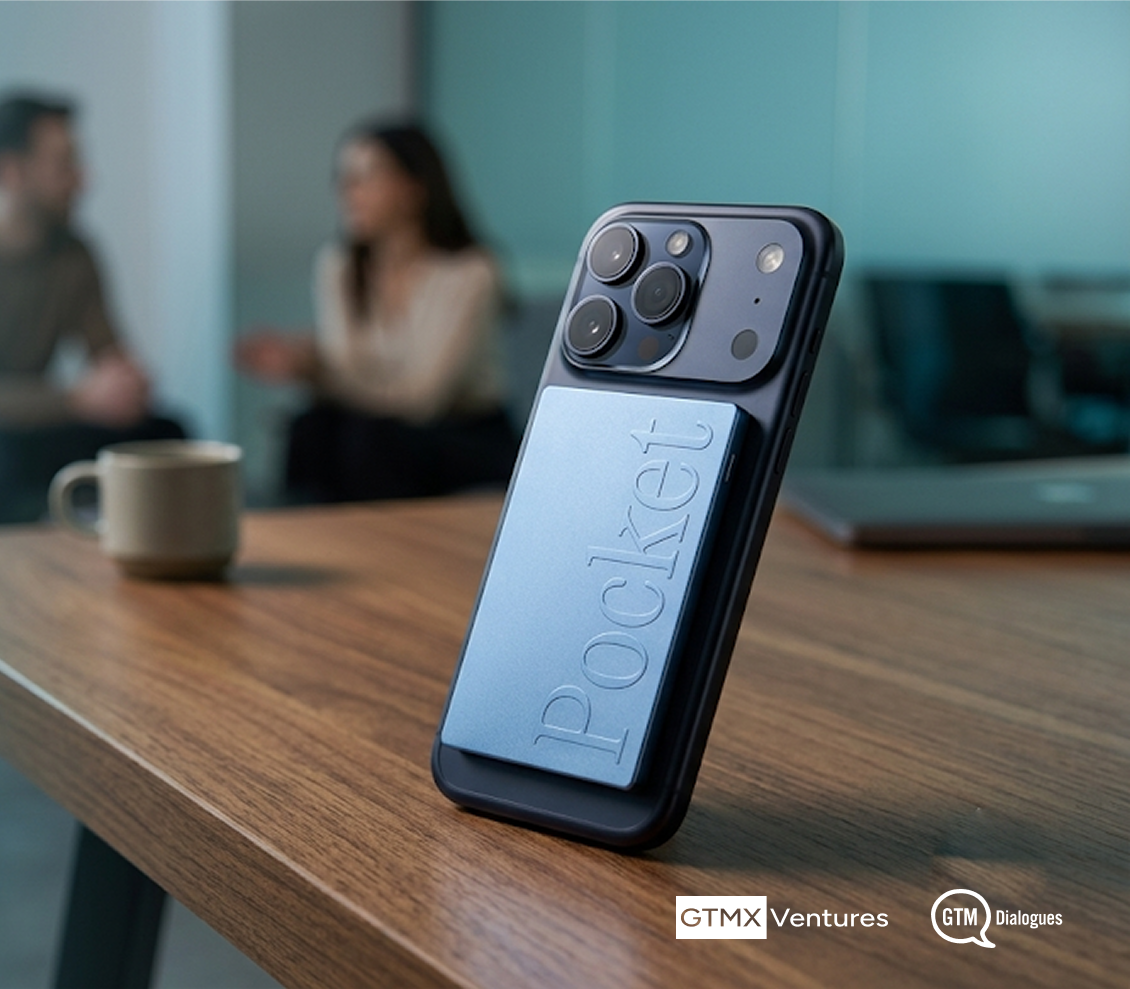
The product bet was specific. Pocket is a roughly 52-gram aluminum puck that clips onto the back of a phone using MagSafe. It carries two studio microphones rated to pick up conversation from 15 meters away, along with a separate contact microphone that captures both sides of a phone call without needing speakerphone, a detail most competitors don't replicate well.
It stores up to 64GB locally, records offline, and syncs later. For a lawyer moving between courtrooms or a field rep working in a parking lot with no signal, that offline-first design is the difference between a device that works everywhere and one that only works at a desk.
An AI Layer That Turns Raw Recordings Into Usable Work
On top of the hardware sits an AI layer that converts recordings into transcripts, speaker-tagged notes, summaries, mind maps, draft emails, and action items. A natural-language query layer called "Ask Pocket" lets users search across their entire recording history the way they'd ask a colleague to recall a conversation from memory.
The hardware captured the moment and the software turned that moment into something a user could act on without listening back to the whole recording.
The Pricing Trick That Turned a Hardware Sale Into a Growth Funnel
A hardware company usually treats price as a number that covers cost and margin. Pocket treated it as a growth lever, and that decision shaped everything that came after it.
The hardware itself, priced between $99 and $129, ships with core transcription included at no extra cost. There is no subscription required to use the basic function of the device. That single choice turned the hardware into an acquisition funnel rather than a one-time sale. A Pro subscription, priced between $16.99 and $19.99 a month, then monetizes the users who want more out of the product: deeper search, longer history, and the full AI layer.
The result shows up clearly in the revenue mix, where roughly 54% of Pocket's revenue comes from subscriptions, with the remaining 46% from hardware sales. For a company this early in a hardware category, that split is unusually software-heavy, and it points to a funnel that was doing more work than the device specs alone could explain.
How Pocket Grew Without a Sales Team
At a $99 to $129 price point, a traditional sales motion doesn't pencil out. The cost of a sales team scales with headcount, but affiliates and referrals scale with revenue itself, and Pocket built its entire growth engine around that math.
Affiliates were chosen for their profession. Instead of running broad influencer campaigns, Pocket built affiliate relationships specifically with healthcare providers, other B2B partners, and content creators. These are professions that map directly onto the off-screen conversation wedge the company was built around from day one. That was their channel strategy instead of spray and pray.
Referrals turned existing customers into an acquisition channel. Pocket offered free months of Pro in exchange for referrals. That turned existing customers into an acquisition channel with close to zero marginal cost, compounding on top of the affiliate layer rather than competing with it.
The community became a growth surface instead of a support inbox. Founders posted milestones, including the $100 million ARR moment, directly to their user community. They credited users for the growth and asked them to keep sharing how they use the product. Most early-stage teams treat their community as a place to answer questions and not a channel that can drive new demand.
Unpaid customer logos did more than a testimonial campaign could. Rather than running paid testimonials, Pocket leaned on the fact that people at Uber, Google, Amazon, and Vercel were already using the device. That is free social proof from users other potential buyers already recognize and trust.
The launch itself became a free growth channel. The Y Combinator launch, and the organic review cycle it kicked off on TikTok and YouTube, worked as a second top-of-funnel layered on top of the affiliate program. None of that required a media budget.
Capital showed up after the curve had already bent. The $11 million Series A, led by Accel with participation from operator angels including Vercel's Guillermo Rauch and ElevenLabs' Mati Staniszewski, closed in June 2026. That was three months after launch, once ARR was already at $27 million and growing 50% month over month. The money accelerated a motion that was already working, it didn't fund the search for one.
None of this required inventing demand. It required removing the friction between wanting the product and buying it, then letting the people who already bought it do the selling.
What Pocket's Growth Timeline Actually Looked Like, Month by Month
Looking at Pocket's growth on a chart makes it tempting to see one clean line from $1 million to $100 million. Laid out on a calendar, it actually moved in distinct jumps, each tied to a specific event rather than a steady climb.
Late 2025: Pocket was still pre-launch, sitting at single-digit millions in ARR.
March 2026: The company launched alongside its Y Combinator batch. ARR hit $27 million, with more than 30,000 units shipped in five months and 50% month-over-month growth.
June 2026: The $11 million Series A closed, 3 months after launch and once the growth curve had already proven itself.
August 19, 2026: Pocket crossed $100 million ARR, with more than 270,000 devices shipped and a team of roughly 15 people running the entire operation.
Each jump lines up with a launch, a raise, or an affiliate program scaling up, not a gradual slope. That matters because a smooth growth chart can make hypergrowth look inevitable in hindsight, when it was actually a series of specific decisions landing at specific moments.
The Trust Infrastructure Pocket Still Needs to Build
Growing this fast creates its own kind of debt. It is the security, compliance, and support infrastructure that takes longer to build than ARR takes to climb, and Pocket's first year shows early signs of that bill coming due.
In February 2026, the company disclosed a hallucinated transcript issue affecting an estimated 1 to 2% of recordings. There was also at least one reported incident of a customer receiving another customer's transcripts, the kind of failure that carries outsized weight for a product built on private conversations.
Pocket also cut free tier cloud retention from 90 days down to 14 days. That change reportedly cost the company some affiliate goodwill, a sign that an inbound, affiliate-driven growth engine is more sensitive to policy shifts than a sales-led business would be, since affiliates are effectively vouching for the product to their own audiences.
Despite courting healthcare and legal customers, both fields where confidentiality is a core requirement, Pocket doesn't yet have a named GDPR data processing agreement, SOC 2 certification, or ISO 27001 certification. Underneath all of it sits a longer-term platform risk. Apple, Google, and Microsoft are each absorbing pieces of this exact use case at the OS level, through native call recording and bundled meeting notes, and offering it for free.
What Founders Building Hardware Can Take From Pocket's First Year
Pocket's approach offers a set of decisions that other founders can study and apply to their own categories, even outside hardware.
The first is finding a wedge inside a category that already exists rather than inventing a new one. AI note taking wasn't a new idea when Pocket started. The company won by noticing that every competitor had built for Zoom, and nobody had built for the room. That kind of gap is often sitting in plain sight inside a crowded market, waiting for someone to notice what everyone else optimized around.
The second is letting price do the work a marketing budget usually has to do. A hardware funnel with no subscription requirement, paired with a paid software layer for power users, brought in more customers than any campaign could have. The business model itself became a growth channel, which meant every dollar spent on the product doubled as a dollar spent on acquisition.
The third is building a channel strategy instead of a sales team when the price point doesn't support one. Pocket's affiliate program worked because it targeted specific professions tied directly to the product's wedge. A smaller, more targeted channel list outperformed a broader one.
The fourth is treating early users as a distribution channel rather than only a support queue. Community-led announcements and referral incentives compounded Pocket's acquisition at close to zero marginal cost. Founders who only look to their community for support tickets are leaving a growth channel unused.
The fifth is raising capital once the curve has already bent. Pocket's Series A closed after ARR had already reached $27 million and was growing 50% month over month. The capital accelerated a motion that was already working rather than funding a search for product market fit.
The sixth is planning for the cost of security, compliance, and support capacity before growth forces the issue. That bill comes due for every company that scales this quickly, and founders who build for it early tend to fare better than the ones who get surprised by it later.
The exact curve, one million dollars to one hundred million dollars in 7 months, took a specific mix of category timing, YC's launch platform, and a founder willing to price the hardware as a funnel instead of a product. Most founders won't have all three at once. The individual decisions, pricing for acquisition, choosing affiliates by profession, treating users as a distribution channel, are available to any founder building in any category right now.
Saurabh Lahoti
Saurabh Lahoti is the founder of GTMDialogues, helping early-stage B2B startups scale with sharper GTM strategy, inbound marketing, and founder-led storytelling.






.png)
.png)
.png)