GTM Strategies
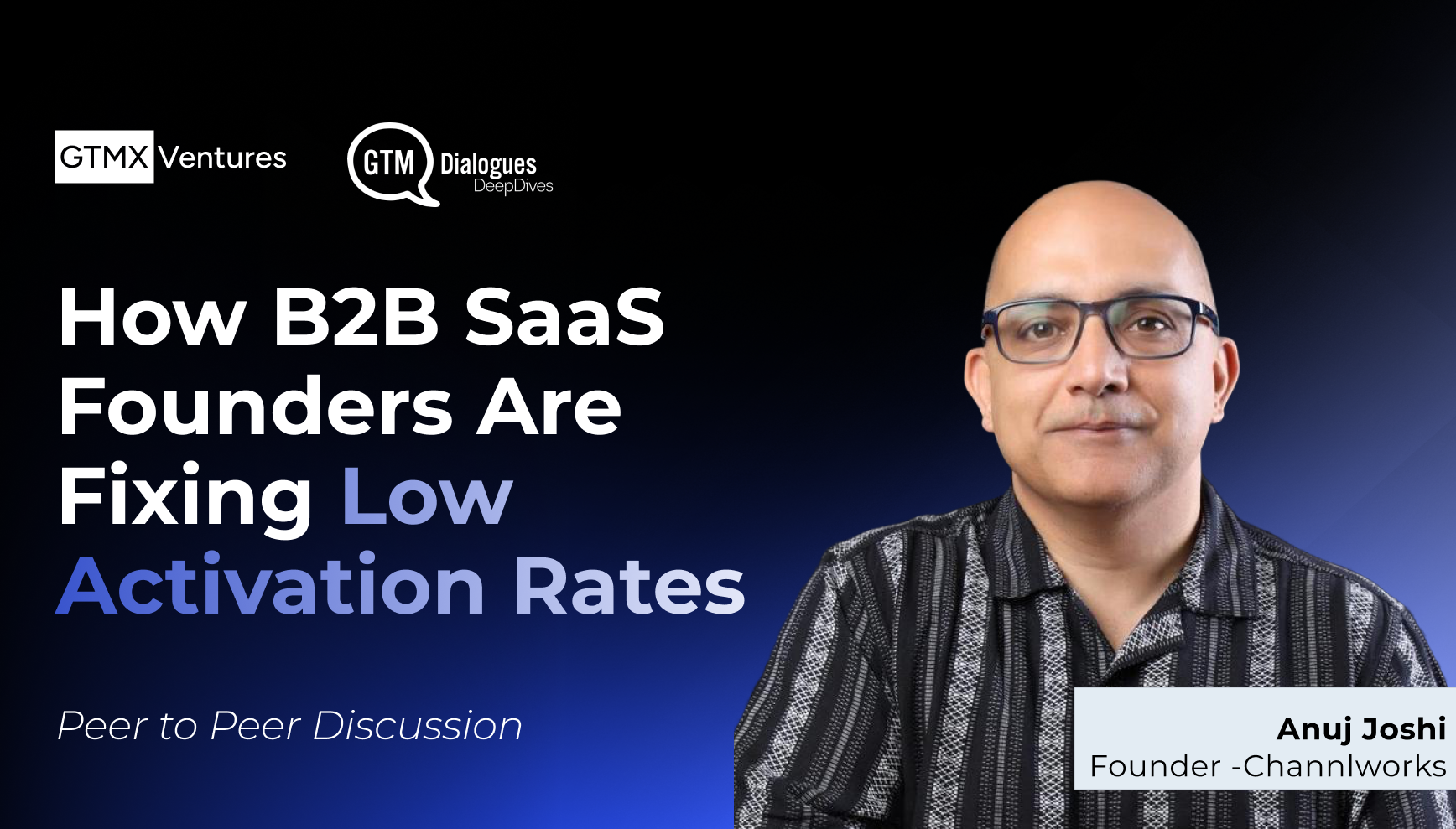
How B2B SaaS Founders Are Fixing Low Activation Rates
May 20
•
12
min read
1 to 10 Stage

A Founder Relations specialist focused on building meaningful connections and opportunities to support their growth.

A Founder Relations specialist focused on building meaningful connections and opportunities to support their growth.
Every PLG playbook you have read tells you the same thing. Remove friction, shorten the path to the aha moment, and your activation numbers will climb. It is clean logic, and it makes sense on paper.
But what if the real problem is not how much friction you have, and instead it is who you are letting through the door?
That is the question a group of early-stage B2B SaaS founders sat down to answer in a closed-room peer session hosted by GTM Dialogues.
Anuj Joshi, founder of Channlworks and a PLG-first builder running activation experiments on a product with over 100,000 monthly sign-ups, walked the room through two years of trial, error, and some genuinely surprising outcomes.
Channlworks helps small businesses auto-generate and schedule social media content, a category with high intent at the top of the funnel but notoriously poor conversion in the middle. The activation problem was real, and the standard fixes were not working.
“The crux of intelligence is to learn from other’s mistakes”, Anuj said at the start of the session. What followed was a first-hand account of exactly that.
This article pulls the most useful threads from that conversation, covering the experiments, the outcomes, and the friction paradox that most PLG founders never see coming.
If you are building a self-serve product and watching sign-ups evaporate before they ever convert, the next few sections are worth your full attention.
Before you can fix your activation rate, you need to know exactly where users are falling off and why. Most founders skip this diagnostic step and jump straight to solutions. That is where the guesswork starts.
Most PLG founders track sign-ups closely. What they track far less honestly is what happens right after. The gap between someone creating an account and someone actually experiencing value in your product is where most of your growth problem lives.
Anuj Joshi built a simple but honest way of looking at this at Channlworks. The funnel he tracked goes like this: traffic to impressions, impressions to site visits, site visits to sign-ups, sign-ups to activation, activation to paid conversion, and paid conversion to retention at three, four, and six months.
Every stage has a number. Most founders only panic when the top of the funnel slows down. The real leak, more often than not, is sitting quietly in the middle.
When Anuj looked at that middle section closely, a pattern emerged that reframed the entire activation problem at Channlworks.
Half Your Sign-Ups May Never Have Intended to Convert in the First Place:
Channlworks was pulling in roughly 100,000 sign-ups a month at the time of these experiments. On the surface, that looks like a healthy acquisition machine.
But when Anuj and his team looked closer, nearly half of those sign-ups were what he called "travelling users." They came in, clicked around, and left without generating a single piece of content.
“The larger problem was how do we identify whether they intended to do something or they did not have any intent itself, or they had just come here to window shop”
This distinction matters more than most founders realise. If half your sign-ups were never going to convert regardless of how smooth your onboarding is, then optimising onboarding flow alone is solving the wrong problem.
The product team at Channlworks believed the acquired users were low quality. The growth team believed the product was not doing enough to show value fast enough. Both sides were partially right, and that tension is exactly where the real experimentation began.
When your activation numbers are flat, the first instinct is almost always the same. Make it easier. Reduce the steps. Get the user to value faster. Anuj Joshi followed that instinct first, and what happened next is worth paying close attention to.
The first round of experiments at Channlworks was textbook PLG thinking. Anuj and his team counted every click it took for a new user to go from sign-up to generating their first piece of content. Then they set about cutting that number down.
They tested shorter onboarding flows, simplified navigation, and guided tooltips that walked users through each step of the product. Every change was A/B tested against a control group, with 30 to 50% of users seeing the new version at any given time.
They also tested what Anuj called the "cheerleader effect." Instead of showing a new user one piece of generated content, Channlworks showed them four, five, or six pieces at once. The idea was that seeing a larger variety of output right away would make the value more immediate and harder to ignore.
After running these experiments across a large enough sample, the activation numbers did not shift in any meaningful way. Sign-up volumes stayed the same, and the users who were dropping off continued to drop off at roughly the same rate.
Anuj said, “We were not seeing a significant change in terms of our metrics. We were still not sure why it was happening”.
The guided onboarding, the shorter click paths, the cheerleader content display — none of it changed the fundamental behaviour of users who had no real intent to begin with. You cannot onboard someone into wanting your product.
This is the part most PLG founders do not want to hear. A frictionless onboarding experience is only as good as the quality of the user walking through it. When half your sign-ups are window shoppers, making the window prettier does not make them buyers.
What Anuj and his team needed was not a smoother funnel. They needed a filter. And that shift in thinking led directly to the second experiment, which produced results nobody in the room had expected.
After the first round of experiments failed to move activation numbers, Anuj Joshi and his team at Channlworks made a decision that goes against almost everything the standard PLG literature recommends. Instead of continuing to remove friction, they started adding it deliberately. Here is what that looked like in practice.
The second experiment started with a new onboarding screen. When a user signed up to Channlworks, they were now required to answer a set of questions before they could access the product. What will you use this for? What best describes you? Where did you discover us? Do you have a business website?
None of these questions was optional. Every single one was compulsory, and users had to complete all of them before they could move forward. If they had a website, Channlworks would auto-populate their brand details. If they did not, they still had to manually enter a brand name and business description before proceeding.
The questions served two purposes at once. They helped the team understand who was actually coming through the door, and they educated users about the different things Channlworks could do for them, all before they had even seen the product.
After the persona questions, users now hit a credit card wall. No card, no access. The free trial was still available, but you had to put in your payment details to start it.
On paper, this looks like a conversion killer. You have just added six compulsory questions and a credit card requirement to a sign-up flow that was already struggling to retain users. The expectation would be a significant drop in the number of people reaching the product.
“I you can guess which of the experiments worked well,, experiment to basically, there was a 3x increase in final paid conversion”, Anuj told the room.
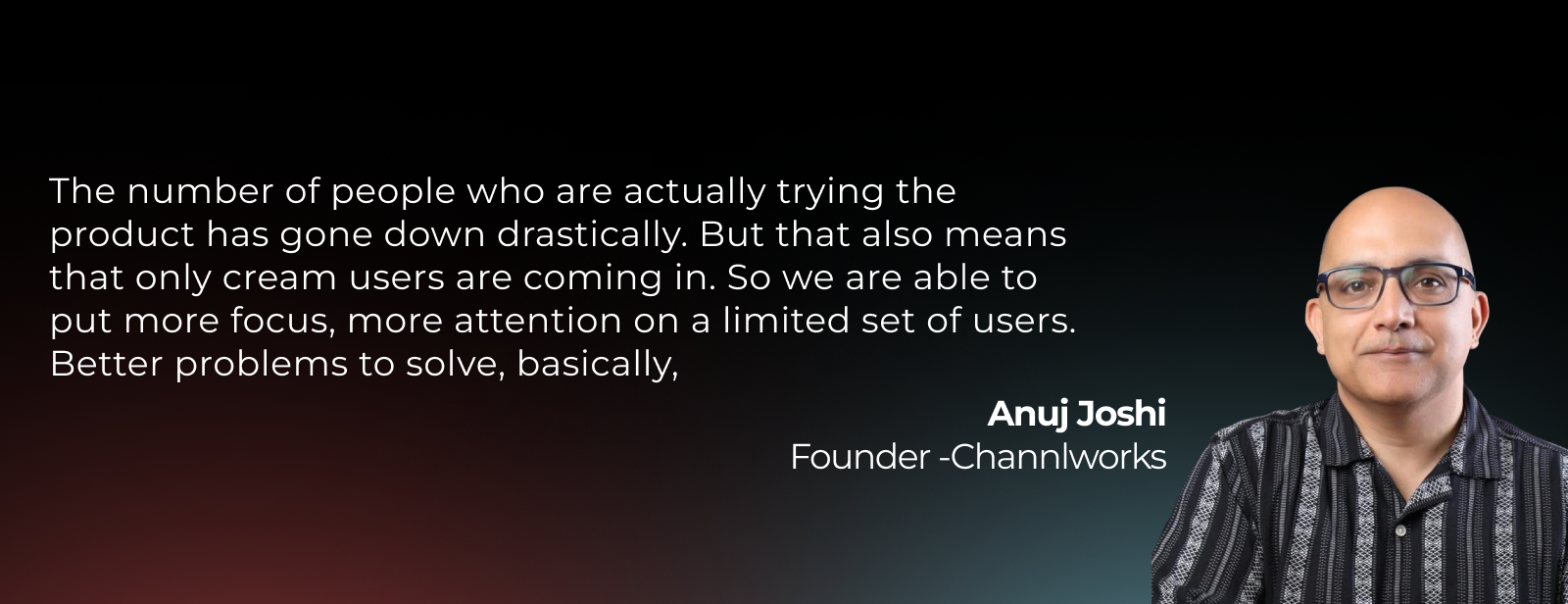
The volume of users entering the product dropped sharply, as expected. But the users who did make it through were genuinely interested, and they converted at a rate that more than made up for the drop in volume.
The credit card step did not just filter out window shoppers. It changed the quality of every conversation, every support interaction, and every product decision that followed.
There is a reason this result surprised even Anuj. The assumption going in was that asking for a card would hurt. What it actually did was self-select for users who had already decided they were serious, before they ever touched the product.
The friction was a qualifier. And once the team understood that, the question shifted from how do we remove more friction to how much friction is the right amount before the numbers start to dip again.
Once Channlworks had the right users coming through the door, the next question became what to do with them during the trial period. The length of a trial, how much access you give, and what you restrict during it are decisions most founders make once and rarely revisit. Anuj Joshi revisited all three, and each change taught him something different.
Channlworks started with a seven-day free trial. Users could pick any plan, access all features, and experience the full product before being charged at the end of the seventh day. It felt generous, and generosity felt like the right strategy for a PLG product.
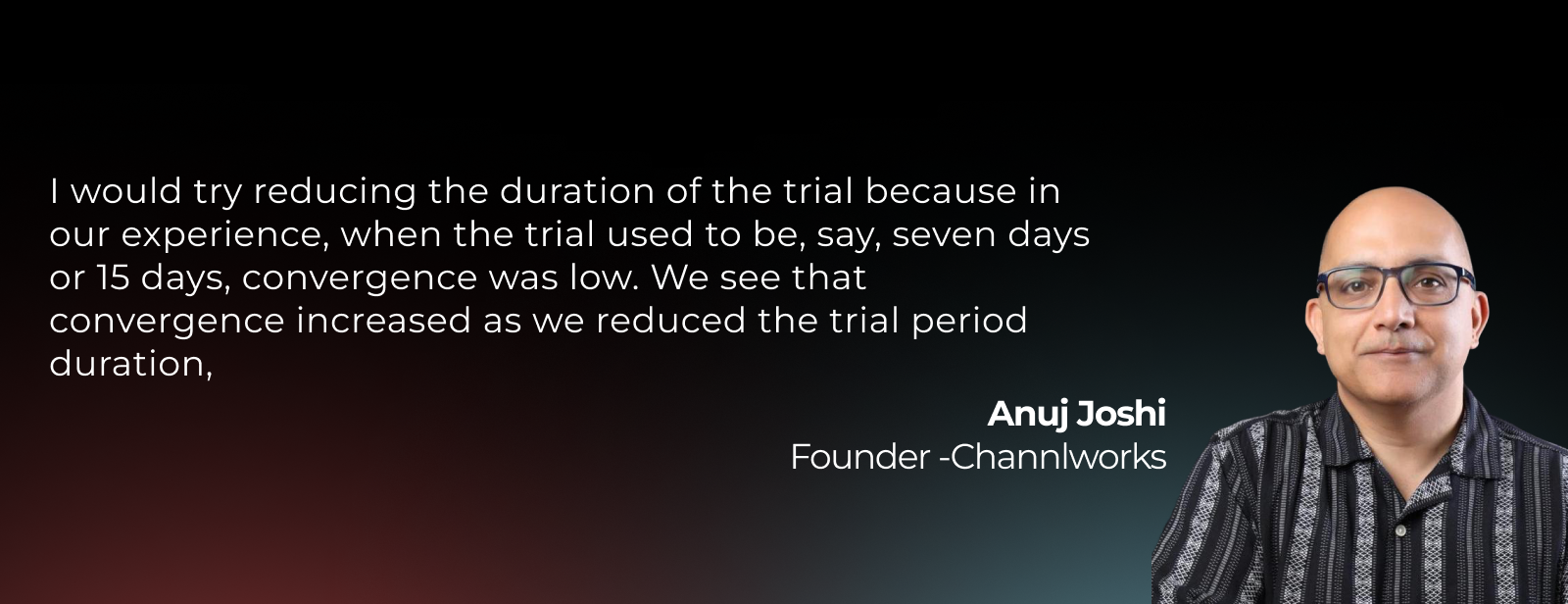
The data said otherwise. Longer trials did not produce more conversions. They produced more procrastination. Users who had seven days to decide almost always made the decision on day six or seven, which meant a week of usage data and engagement that never translated into the conviction needed to convert.
The second layer of the trial experiment came from a usage insight that Channlworks spotted in their data. The top 10% of trial users were consuming 60 to 70 percent of all AI credits on the platform. That meant a small group of heavy users was running up significant infrastructure costs during a period when Channlworks was making zero revenue from them.
The team made three targeted changes to fix this:
Each of these changes made the trial feel less like a free product and more like a preview with a clear next step.
Channlworks had a free plan sitting on their pricing page alongside paid tiers. Heat map data showed that the free plan option was getting the highest number of clicks on the entire page.
When the team removed the free plan entirely, conversions on the pricing page dropped by thirty percent initially. Anuj made his position on that outcome clear that, “I’m happier, I’m okay when finally we are making better, good revenue after that”, he said .
The thirty percent drop represented users who were never going to pay. Removing the free plan did not cost Channlworks paying customers. It just stopped the illusion that free users were a meaningful pipeline.
Across all three of these adjustments, a single principle kept showing up. The less you give away without commitment, the more clearly you can see who actually wants what you have built. Shortening the trial, capping credits, removing free access — none of these are about being stingy. They are about creating the conditions where only serious users move forward.
Activation strategy is not a problem exclusive to PLG companies. The same fundamental challenge, getting the right user to experience real value before they walk away, exists in sales-led products too. It just shows up differently. Another founder in the session, running a WhatsApp-based marketing automation platform with a primarily SLG motion, shared what his team had been working through, and the parallels with Anuj Joshi's experiments were hard to ignore.
The WhatsApp automation platform in question serves multiple verticals, from direct-to-consumer brands to education, healthcare, and banking. Its activation moment is not a product feature. It is a booked demo. And getting a qualified lead to that demo was where the drop-off was happening.
The team had a two-stage booking flow. A short form collected the user's name and email, and then a calendar booking link followed on the next page. The drop-off between the two pages was steep, and the reason turned out to be embarrassingly simple.
Once the booking flow was cleaner, the next issue surfaced. A large portion of the leads coming through were low quality, and the sales team was spending time qualifying people who were never going to buy.
The team tried mandating business email addresses on the form to filter out casual sign-ups. The logic was sound, but the execution backfired for two reasons:
Registrations dropped by fifteen to sixteen percent before the team reversed the decision and opened the form back up.
Rather than using form fields to filter leads, the team built a human qualification step into the process. Anyone signing up with a business email got a direct calendar link. Everyone else was routed to a salesperson who would reach out within fifteen to twenty minutes and assess the lead before passing on a demo slot.
This approach did three things at once. It protected the sales team's time, it improved the quality of demos being conducted, and it made the pipeline feel more intentional on both sides.
On the activation side, the team also moved from monthly plans to a minimum quarterly commitment and shortened their trial period from thirty days to five or six days. The pattern matched exactly what Channlworks had found.
The SLG experience reinforced something the PLG experiments had already suggested. Whether your activation moment is a product feature or a sales demo, the principle is the same. The faster you create a real commitment from the user, and the sooner you show them something of genuine value, the better your conversion numbers will look.
Most founders assume that what works for activation in one market will carry over to the next. You have the product, you have the funnel, and you have data from a market that is already converting. Surely the numbers will follow.
What Anuj Joshi found when Channlworks expanded beyond India told a very different story, and the differences were not small.
Channlworks was running the same product, the same onboarding flow, and the same trial structure across multiple geographies. The only variable was the market. The conversion numbers that came back made the team rethink almost everything they assumed about user behaviour outside India.
Here is what the data showed across regions, measured by the percentage of sign-ups who went on to enter their credit card details:
Beyond the headline conversion numbers, the team found that the format of the trial itself needed to change depending on geography. A single trial structure was not going to work across all markets.
One market-specific shift that moved Channlworks' India numbers in a meaningful way had nothing to do with the product or the trial structure. It came from a payment infrastructure change.
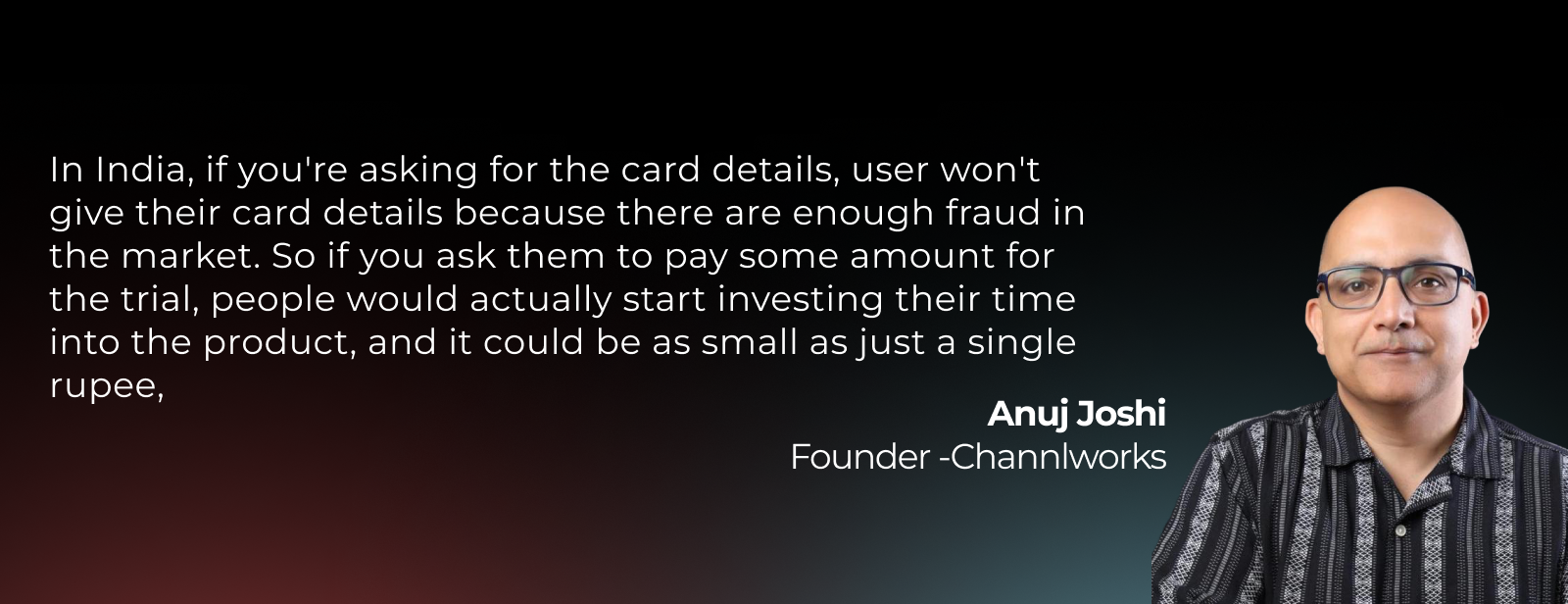
Before UPI Auto was widely available, asking Indian users to enter card details created a genuine drop-off point. The moment UPI Auto became an option, the payment step became far less intimidating. Users were already comfortable with UPI for everyday transactions, and the familiarity carried over directly into the product sign-up flow..
The geographic data from Channlworks makes one thing very clear. Activation strategy is not a single playbook you build once and apply everywhere.
The market your user is in shapes their trust level, their payment comfort, and their willingness to commit before they have experienced the full product. If you are expanding internationally, your conversion assumptions need to be rebuilt from scratch for each market you enter.
Getting your activation funnel right is only half the equation. The quality of users who reach that funnel depends entirely on where they are coming from. During the session, the conversation moved naturally from activation experiments to acquisition, and what Channlworks had built on the discovery side was just as deliberate as what they had built inside the product.
Channlworks runs three acquisition channels, and they are not weighted equally. Each one serves a different purpose in the overall motion, and understanding what each channel does versus what it cannot do is what keeps the strategy from becoming scattered.
The three channels, in order of volume contribution, are:
The influencer strategy at Channlworks is not a brand deal in the traditional sense. There is no barter, no gifting, and no affiliate arrangement. Creators quote a fee, Channlworks negotiates, and both sides agree on a number.
What makes this work for a product like Channlworks is the nature of the audience. Small business owners and e-commerce merchants, the core users of the product, actively follow creators who talk about running a business, growing on social media, and tools that save time. A recommendation from a creator they already trust lands differently than a search result or a display ad.
One acquisition trend that came up in the session was the growing role of AI-powered search in driving users to Channlworks. Users searching for terms like "best AI content generator" or "best social media tool" inside ChatGPT or similar tools were landing on Channlworks, but the attribution was impossible to pin down cleanly.
The SEO team believed the traffic was coming from traditional search. The influencer team believed their content was driving the direct visits. The honest answer, as Anuj put it, was that nobody knew for certain.
This is not a Channlworks-specific problem. As AI search becomes a more common starting point for product discovery, the standard attribution models that most SaaS teams rely on are becoming less reliable. If you are not already thinking about how your product shows up in AI-generated recommendations, your acquisition picture is probably incomplete.
Another acquisition insight from the session came from a different founder, whose product relies heavily on mobile app discovery. The reasoning behind this was straightforward. When users are running social media ads and the entire user journey happens on a mobile device, the cost per conversion through a mobile app is significantly lower than driving the same user to a web product.
The approach they described was to use the mobile app as the discovery and trial surface, then gradually move engaged users to the web product for deeper functionality. The app handled the first impression; the web product handled retention and expansion.
If your product has a mobile surface that you are not actively investing in for discovery, this is a channel worth pressure-testing before writing it off.
By the time the session reached its final stretch, the conversation had moved past individual experiments and into a bigger structural question. One that every founder in the room was either already facing or knew was coming. What happens when your PLG motion starts working, but a larger customer shows up and wants to talk to a human? Anuj Joshi put it plainly, and it landed with the room.
The promise of product-led growth is that the product does the selling. Users sign up, experience value, convert, and expand, all without a sales team in the loop. For a product at Channlworks' stage, that motion makes complete sense. The unit economics work, the team stays lean, and the feedback loop between product and growth is tight.
But PLG has a ceiling that most founders hit without warning. When a larger business finds your product and wants to buy at scale, the self-serve flow is not built for that conversation. There is no account executive to take the call, no proposal process, and no one to negotiate terms with. The product that was supposed to do the selling suddenly has nothing to say to an enterprise buyer.
"In PLG, what happens is you become so PLG in terms of only what the product can do. If there is a larger customer who comes in saying I need to talk to somebody, there is also another different kind of a problem," Anuj said.
For founders who built their company on a sales-led motion and are now trying to shift toward PLG, the challenge runs in the other direction. The entire company DNA is wired for human-first selling. Sales thinks in terms of relationships. Support thinks in terms of tickets. Customer success thinks in terms of QBRs. Asking that organisation to suddenly trust a product to do the work of a person is not a process change. It is a cultural one.
One founder in the room, whose company scaled its sales team to 120 people in three months to meet demand, described exactly this friction when they began the transition to PLG.
"Once you have an established SLG motion, aligning everyone to think from a PLG-first perspective is not there. Right from sales, support, customer success, everyone thinks of this human-first approach. Yes, and it's been a challenge," he said.
The challenge is not just internal either. Customers who were acquired through a high-touch sales process expect that level of attention to continue. Switching them to a self-serve model mid-relationship is a retention risk that most teams underestimate.
What the session made clear is that the PLG versus SLG framing is not a permanent choice. It is a starting point. Most products will eventually need both motions running in parallel, with PLG handling the long tail of self-serve users and a lighter SLG layer ready to catch the larger deals that the product alone cannot close.
The founders in the room were at different points on that journey:
None of them had fully solved it. But all three had enough data to know that the answer lives somewhere in the middle.
The most useful takeaway from this part of the conversation is not a framework. It is a timing question. At what point does your PLG motion start leaving money on the table because there is no human ready to catch the deals that need one?
The founders who answer that question early enough will be the ones who do not have to rebuild their go-to-market from scratch when the ceiling arrives.
Every experiment shared in this session came from a founder who was willing to try something, measure it honestly, and share what happened, including when it did not work.
That kind of peer-level honesty is rare, and it is exactly what makes the lessons here more useful than anything you will find in a generic PLG playbook. Before you close this, here is what is worth carrying into your own product and funnel decisions.
The through-line across every experiment discussed in this session is simple. Your activation problem is almost never about the product experience alone. It is about who you are letting in, what you are asking of them, and how quickly you are creating a moment of real commitment on both sides.
Here are the specific things that moved the needle, pulled directly from what was tested and measured:
There is a reason this session worked. Nobody in the room was selling anything. Nobody was presenting a case study designed to make their decisions look smarter in retrospect.
These were founders sharing live problems, live experiments, and live results with other founders who were close enough to the same stage to actually use what they heard.
That is the format GTMDialogues was built around. Not speakers and audiences, but peers and conversations. If you are an early-stage B2B SaaS founder who is working through activation, conversion, or go-to-market questions right now, the most useful thing you can do is find a room like this one and get into it.
It depends on where your product is in its growth stage and who your target user is. What Channlworks found is that asking for a credit card upfront reduced overall sign-up volume but produced a 3X increase in paid conversion. The users who made it through the gate were serious, and the team could focus its energy on a smaller, higher-quality group. If your current funnel is flooded with users who explore and disappear, a credit card requirement is worth testing before dismissing it as a conversion killer.
Shorter than you think. The data from multiple founders in this session pointed in the same direction. Trials of fifteen days and seven days consistently underperformed trials of five to six days. When users have too much time, they delay the decision. A tighter window creates a natural urgency that a longer trial never does. If you are currently running a trial of more than seven days, reducing it is one of the lowest-effort experiments you can run right now.
This is harder to answer without data, but the session pointed to a few reliable signals. Users who complete a detailed onboarding flow, including questions about their business and use case, are more likely to have real intent than users who skip through a minimal sign-up. Users who enter payment details, even for a paid trial at a very low price point, are self-selecting as serious. And users who return to the product within the first 24 to 48 hours after sign-up are far more likely to convert than those who do not come back until day five or six of a trial.
No, and assuming it does is one of the more expensive mistakes you can make when expanding internationally. Channlworks found that paid trials outperform free trials in India, while free trials work better in Malaysia and the Philippines. GCC markets produced the lowest conversion rates of any region tested, despite the assumption that higher purchasing power would translate into higher conversion. If you are expanding to a new market, treat your activation assumptions as a blank slate and test from scratch rather than porting over what worked at home.
Re-engagement emails are the standard response, and Channlworks used them. But Anuj was honest about the results. Emails get opened, and a small percentage of users, roughly two to three percent, do come back. The larger group does not. The more useful question to ask is whether the users who dropped off were ever genuinely qualified to begin with. If your funnel has a strong enough filter at the top, the volume of users you need to re-engage becomes much smaller, and the ones worth re-engaging are easier to identify.
The honest answer from the session is that most founders wait too long. The signal to watch for is inbound interest from larger customers who want to speak to someone before buying. When that starts happening regularly and your product has no way to catch those conversations, you are leaving revenue on the table. You do not need a full sales team to start. A single person who can handle inbound enterprise interest, run a demo, and close a larger deal is enough to test whether the motion is worth building out further.

A Founder Relations specialist focused on building meaningful connections and opportunities to support their growth.
.png)
.png)