Suvikas Bhandari's Fix for B2B Cold Email Outreach
Jun 22
•
12
min read
US GTM
Community-Led Growth
Event-Led-Growth
Pooja Baranigutta
A Founder Relations specialist focused on building meaningful connections and opportunities to support their growth.
Picture this. You walk up to a complete stranger at a bar in a city you've never visited before. You have about three seconds before they decide whether to talk to you or look away. That's exactly what your cold email does every single time it lands in a US prospect's inbox.
This is how Suvikas Bhandari opened a recent session called Cracking the US Market, hosted by GTMDialogues. As he put it, "we'll start with a pickup line, it's a pickup line problem."
Suvikas Bhandari is a go-to-market specialist at nRev and an enterprise sales veteran who has spent years fixing the exact moment where most outbound efforts quietly die: the first message. The session was built for Indian founders breaking into the US market, but the lessons apply to anyone writing cold emails to strangers an ocean away.
Suvikas walked the room through live email teardowns and real case examples from his own team. This article unpacks those frameworks one by one, starting with the pickup line problem itself.
Why "Companies Don't Buy, People Do" Changes Everything About Your Outbound
In 2014-15, a company called Mynd was trying to scale from 100,000 dollars to 250,000 dollars in revenue, with its sights on the US market. Mynd is a sales training and coaching platform that was selling to a single persona: the VP of Sales Enablement at fast growing, mid-market US companies. Mynd is a unicorn today, but at the time it had around ten paying customers and 1.8 million dollars in funding.
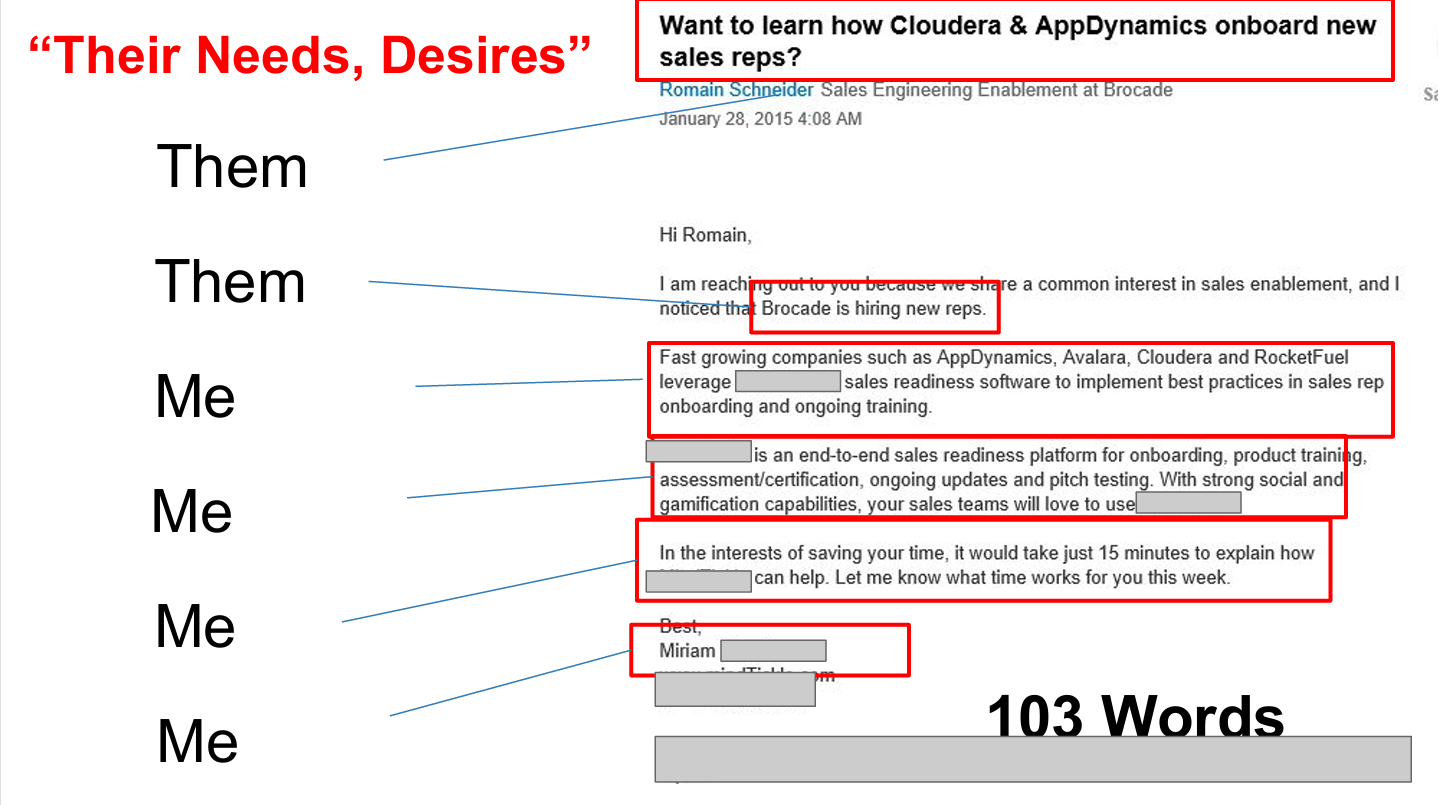
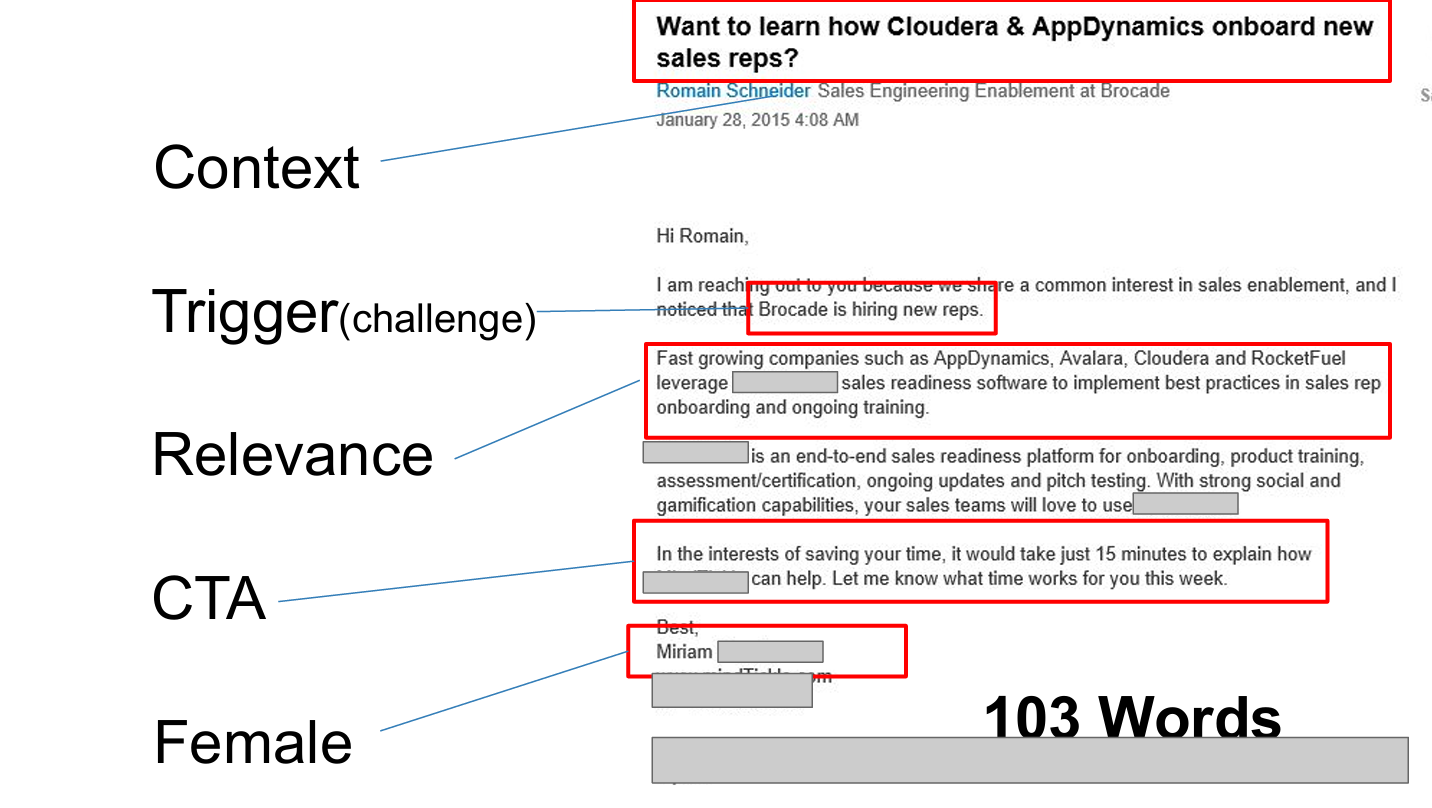
One early email went to the VP of Sales Enablement at Brocade, a listed enterprise company. As Suvikas put it while reviewing that email years later, "we are punching way above our weight. Brocade was a listed company, large enterprise, and we were an unknown entity sitting somewhere in India."
That email went out to roughly 35 prospects in a month. It referenced two recognizable customer names, used a sender with a female name (the team had found female names saw a 30 percent higher response rate), and ran 103 words. It generated zero responses.
"Our emails are mostly me, me, me, me, me," Suvikas said, pointing out that even the first two lines were about Mynd rather than the prospect. The close offered a 15-minute call to "explain how Mynd can help," asking the reader to invest time before they'd been given a reason to care.
This is where the session's central insight landed: companies don't buy, people do. "That's why we created personas," Suvikas said that a persona is an attempt to understand a specific human being's motives, fears, and desires before you write to them.
When Suvikas asked the room how many founders had done a genuinely detailed persona exercise, almost no hands went up. Most teams stop at job title and company size, the same way the Brocade email did, then wonder why a well-targeted email gets silence in return.
Suvikas referenced the old line that to a man with a hammer, everything looks like a nail, a bias often attributed to Charlie Munger or Abraham Maslow. In tech, that shows up as believing a first-message problem can be solved with better tooling. "Can tech solve that first pickup line for you when you approach somebody?" Suvikas asked. "Try your best with GPT and Claude. It's not getting there yet."
That bias is also the subject of an old story about Birbal, who found a man searching for his lost keys under a lamppost, not because he'd lost them there, but because the light was better. Suvikas used it to make a sharp point: most B2B teams pour money into tools like Clay and Apollo because that's where the light is, while the real problem, message quality, sits unsolved in the dark. Is your message failing because you lack the right software, or because you've never built a detailed picture of the human being on the other end?
The Subject Line That Turned a Manchester United Joke Into Five Demo Calls
After the Brocade email went nowhere, Suvikas's team changed the subject line, built from persona research that had been sitting unused.
The team had built a deep profile of each prospect using what Suvikas called the Kundli, a psychographic, demographic, and technographic read on who that person actually was outside their job title. For one prospect, that research surfaced something unusual. The man was a Manchester United fan.
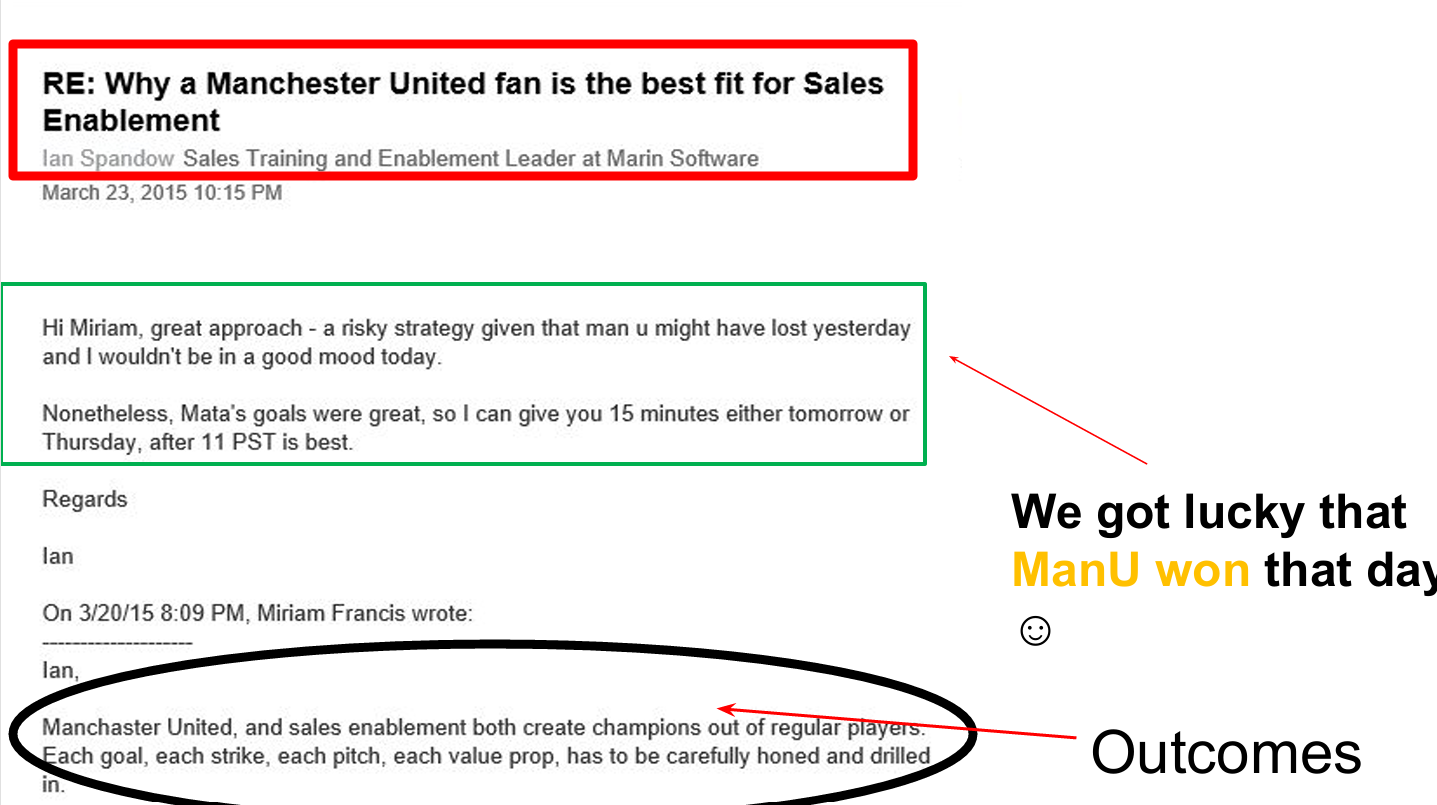
The subject line itself was the question: "Why is a Manchester United fan?" It read like an odd, half-finished thought on purpose, the kind of line a friend would send, not a vendor. As Suvikas described it, "we found that this guy was a Manchester United fan.There was no mention of sales enablement, no mention of Mynd, nothing that signaled this was a sales email at all.
That's exactly what made the prospect respond. He replied in the same tone he'd been written to in, joking that the timing was risky since Manchester United might have lost the day before, which wouldn't have put the sender in good standing. The humor matched the humor. He still gave the team 15 minutes.
The subject line alone wasn't the whole trick. Suvikas connected Manchester United and sales enablement directly in the email body, pointing out that football creates champions out of regular players the same way sales enablement does.
Across that campaign, the team sent 65 emails to 65 unique individuals, with no repeats, and generated five demo calls. "This was an accident," Suvikas said. "We just thought, hey, these are humans, let's use some human feelings." That's a 5-in-65 demo rate, with zero automation and zero list-buying, built entirely on research depth and message relevance.
Suvikas also pointed to a more recent example from his current work with Rev, an agentic AI go-to-market platform for SMB founders and sales leadership. One email opened with curiosity, asking what if the reader knew which companies were actively planning the exact project Rev's product supports, then named the emotional cost of not having that visibility.
Both examples worked for the same reason: neither talked about the product first. Both started with something true about the person reading it.
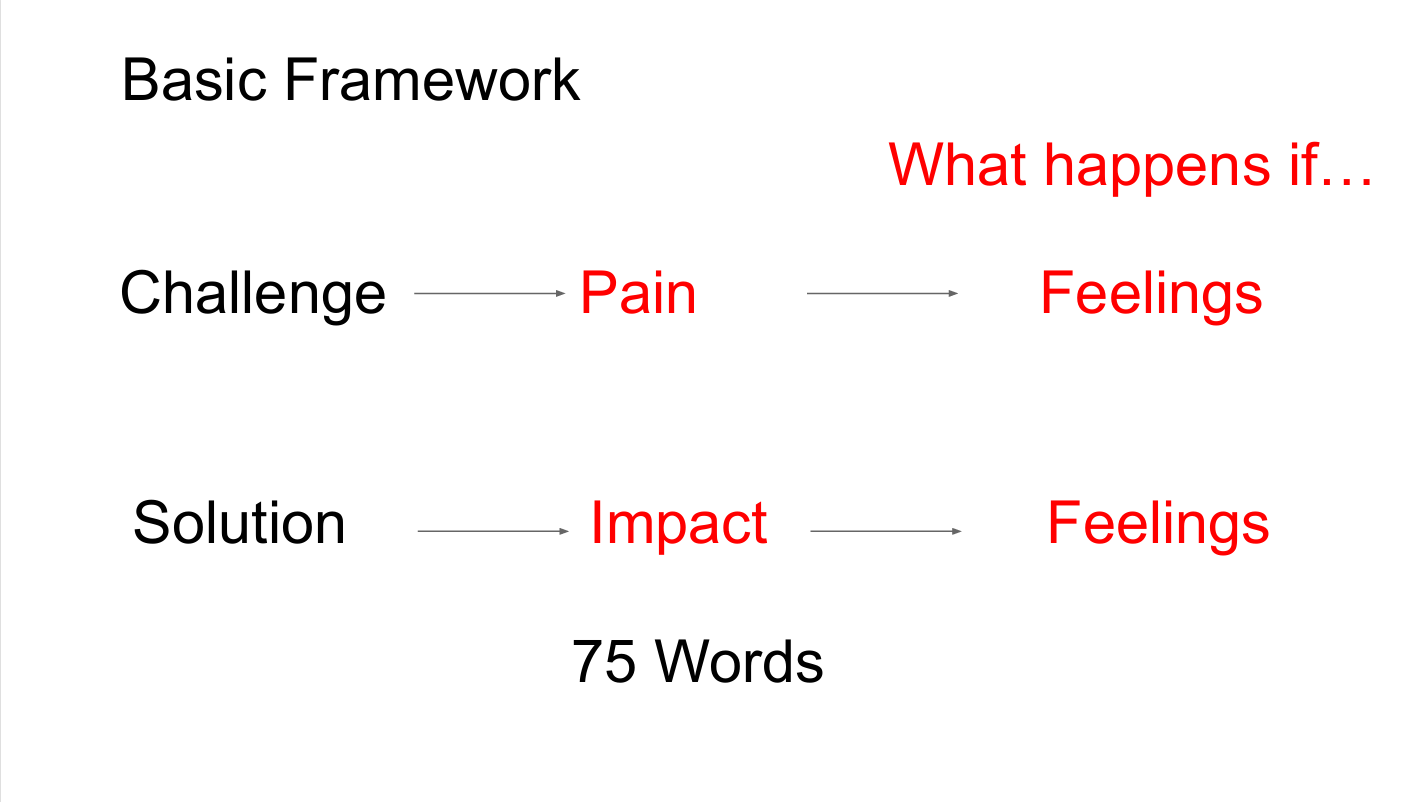
This is where Suvikas introduced the framework his team now uses to structure every cold email: challenge, pain, and feeling on one side, solution, impact, and feeling on the other.
The YYY vs MMM Check Suvikas Bhandari Runs on Every Email
Look back at the Brocade email. The opening lines centered on Mynd, the second line mentioned Mynd's customers, and the close offered 15 minutes to explain what Mynd could do. Almost nothing in it was about the prospect.
Suvikas built a simple naming convention for this: YYY versus MMM. YYY stands for you, your, yours. MMM stands for me, my, mine, or we, our, ours. Most B2B emails fail because they're written almost entirely in MMM.
It's a literal word check. "If you have a word like me, mine, we, our, then that's a problem," Suvikas said. "Make sure you don't have the word me, our, we, at least not till much later in the email."
A line written in MMM sounds like introducing yourself before you've earned the right to. A line written in YYY sounds like you already understand the person you're writing to. As Suvikas put it, "it's about you, your issues, your challenges, your feelings, your desires."
During the session's live email teardown, one participant's email was reviewed on screen. "Unfortunately, it doesn't stand up to the YYY framework," Suvikas said, pointing out the email broke the rule in its first line. The check isn't a one-time campaign edit, it's something you apply to a single line in seconds, the moment you've written it.
If the first line still contains "me," "my," or "we," that's the line to rewrite first. Once your email passes the YYY check, the next question is what to actually say in those You-focused lines, which is exactly what the Challenge-Pain-Feeling structure answers.
The ‘Challenge-Pain-Feeling’ Framework Suvikas Bhandari Teaches in Every Teardown
By the time the session reached Santosh's email teardown, the room had already learned two rules: keep it in YYY, and make the first line earn the second. The next question Suvikas Bhandari tackled was what those You-focused lines should actually say. The answer was a four-part sequence he's used across hundreds of outbound emails: challenge, pain, feeling, on one side, and solution, impact, feeling, on the other.
Part one: name the challenge, one at a time
The challenge is the specific problem your product or service addresses. Suvikas was firm that this needs to be singular per email. "Always pick only one point at a time," he said. "If you have three or four key challenges, send four different emails with different subject lines, because you don't know which one's going to work."
That single rule prevents one of the most common cold email mistakes, where a founder tries to cover every possible pain point in one message and ends up speaking to no one in particular.
Part two: connect the challenge to a real cost
Once the challenge is named, the framework asks what it costs the prospect, whether that's money, time, or risk. Suvikas pushed for specificity here the same way he pushed for specificity in the persona research, because a vague cost doesn't register with a reader the same way a specific one does.
Part three: name the person's feeling
This is the step Suvikas treated as non-negotiable. "It's more important to have what is that human feeling," he said. "If that pain is not solved, what is the feeling?" The feeling has to belong to the actual human reading the email. As he put it bluntly, "the pain has to be of that person only, otherwise that's useless."
Then the mirror: solution, impact, feeling
Once the challenge side is built, the same three-step logic runs in reverse for the solution. What you offer, what changes because of it, and how the prospect feels once that change happens. The two halves of the framework mirror each other so the email reads as one continuous emotional arc.
The test before you hit send
Suvikas closed this part of the session with the same instruction he'd given throughout: go back to the pickup line. Does the line create enough curiosity that a stranger would let you in for one more line? An email that still reads like a feature list has had the framework labeled onto it, not applied.
This challenge-pain-feeling structure also explains something that comes up constantly in B2B outbound: why two emails about the exact same product can get completely different response rates. The feeling being spoken to is usually the variable that moved.
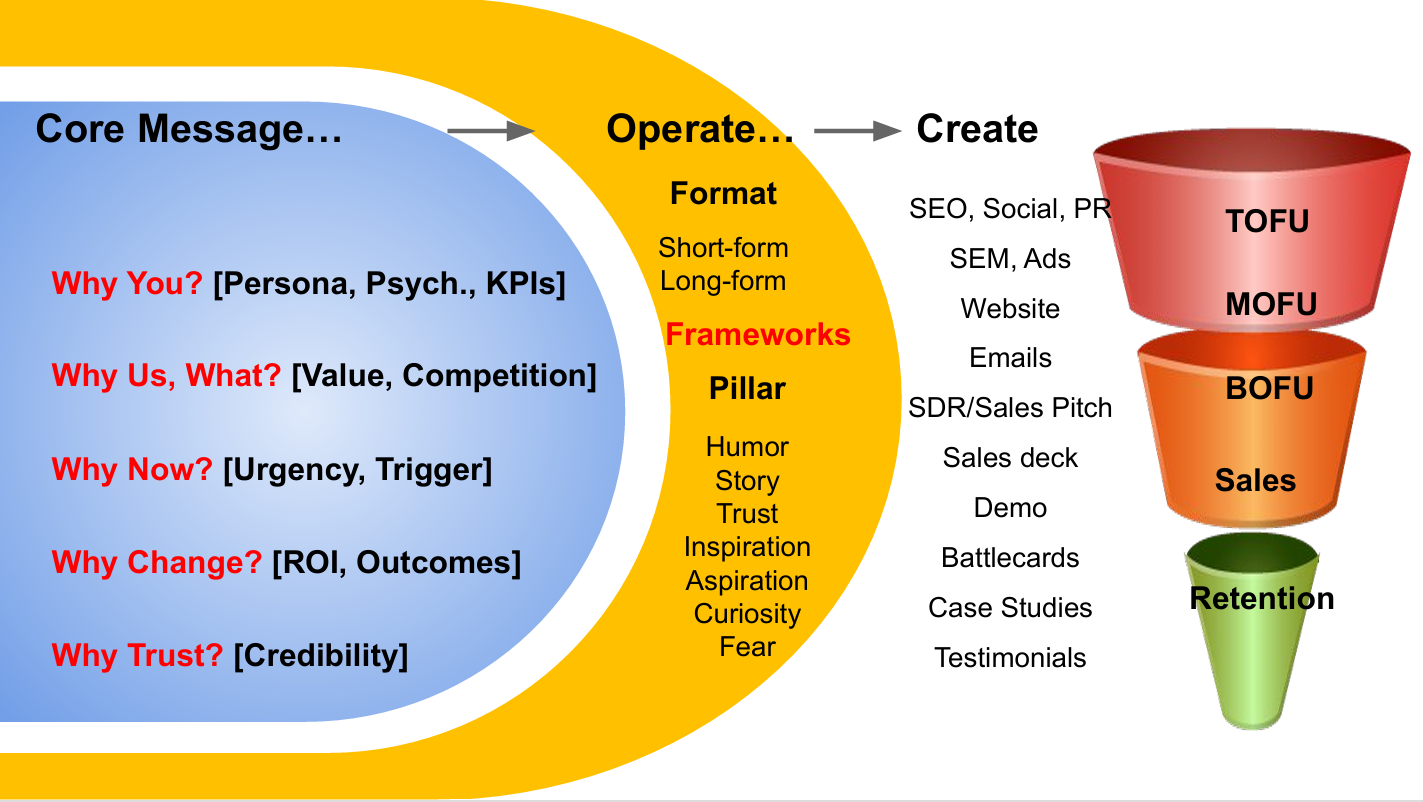
The Five Questions Suvikas Bhandari Says Every Buyer Asks Before Replying
Suvikas spent six years as an enterprise sales rep before building Mynd, closing deals with names like Johnson & Johnson and AstraZeneca across the APAC pharma and FMCG verticals. Out of that came a structure he now uses to evaluate every piece of outbound content: five questions every sales conversation has to answer.
> Why you
The persona question. Is the person you're writing to relevant to this conversation, based on their psychographics, role, and the KPIs they're judged on?
> Why me
Why you, specifically, deserve fifteen minutes of someone's time. Suvikas framed it sharply: "we talk about not just the value we bring, but what the competitor cannot bring."
> Why now
The urgency question. What's the trigger, the change in the prospect's world, that makes this the right moment to act?
> Why change
The outcome question: Does switching produce enough ROI to justify the disruption of changing anything at all?
This is the single most expensive gap in most B2B pipelines. "You will lose 70 percent of your deals between why now and why change, if unaddressed," Suvikas said. For a team closing 15 percent of its qualified leads, that means 70 percent of the 85 percent that got away died in these two questions.
> Why trust
Credibility. The prospect needs a reason to believe the first four answers are true, beyond the standard claims every vendor makes.
Pick which of the five questions a given email or page needs to answer, and build that one piece around it instead of cramming all five into a single message. Every output should carry an emotional pillar underneath it: humor, story, trust, fear, curiosity, or aspiration.
How Suvikas Turns Old Sales Calls Into a Ten-Day Core Message
"If you don't have it, all you need is transcripts of your audio calls," Suvikas said. The five questions need a tool pointed at conversations you've already had.
Turn recordings into raw material
Every sales call already contains pieces of why you, why me, why now, why change, and why trust, scattered across what prospects said about their problems and what eventually convinced them.
Let AI sort the transcripts into five buckets
"Use AI, you won't go wrong," Suvikas said. Convert transcripts into the five sets that match the five questions: persona detail, KPI language, value differentiation, or competitive positioning.
Give yourself ten days
"In ten days, you have the core message ready," Suvikas said, adding that if you genuinely don't have it after that, the only thing missing is more call recordings.
Apply it to your website and emails
Suvikas pointed to David Ogilvy's marketing principles and Fletch PMM's homepage positioning structure for your site, since both make sure a homepage answers all five questions. For emails, he named Claude Hopkins's scientific advertising principles and the writing approach of Rafael Sansores, whom he described as David Ogilvy's own influence.
Every email and homepage line built from this process has to stay in You language: your issues, your challenges, your feelings, your desires. Miss that in even one line, and you lose the person you were writing to.
The Feelings Wheel Suvikas Uses to Find the Right Word for Pain
Every framework so far asks for the same ingredient: a feeling. Suvikas's closing point addressed where that vocabulary is supposed to come from when you're not naturally a writer.
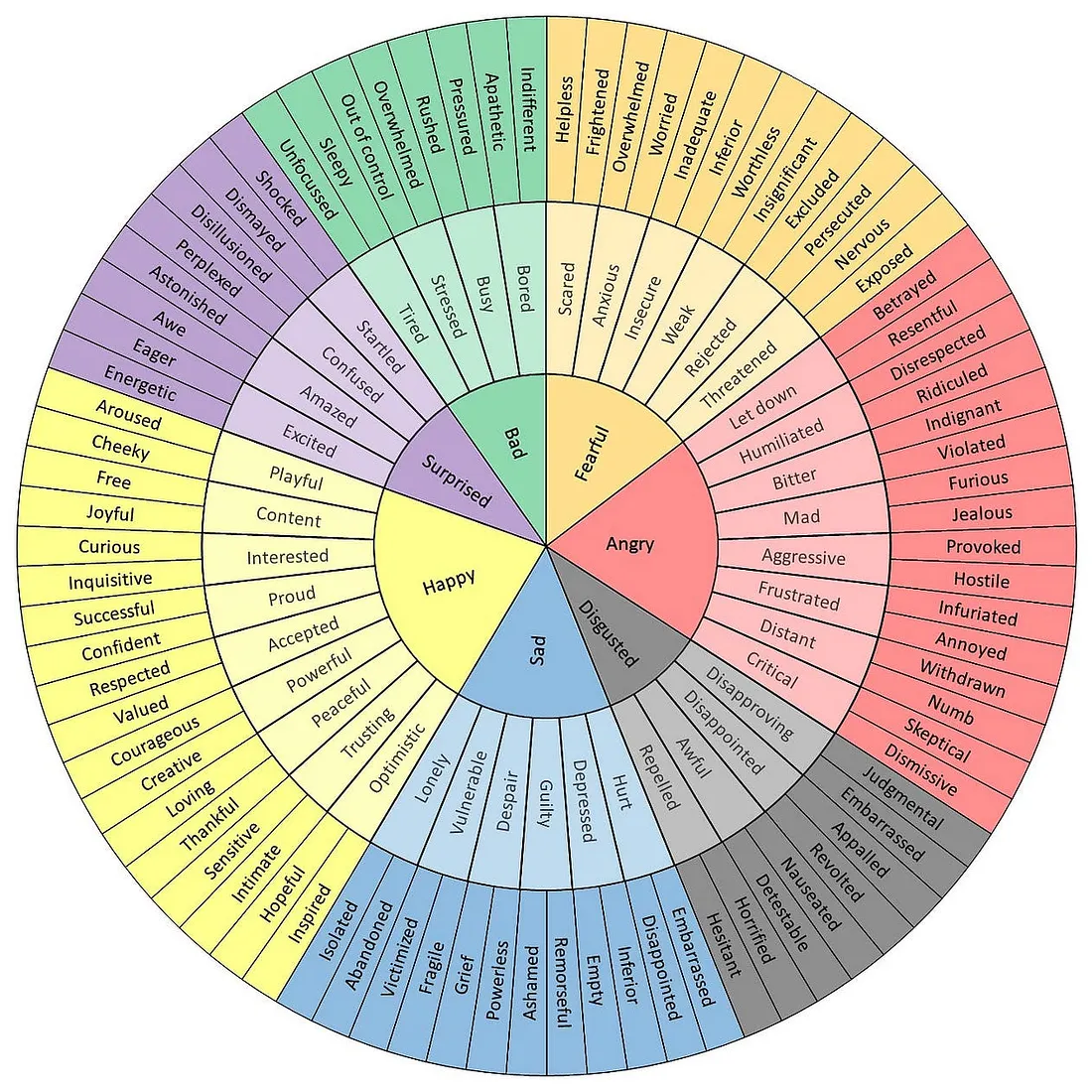
His answer was borrowed from psychiatry. The feelings wheel, developed from the work of Robert Plutchik and Gloria Willcox, maps the full range of human emotion in layers, from a handful of core feelings into dozens of more specific ones.
The wheel gives you words you wouldn't think to use
Most people, asked how they feel about a recurring problem, say something generic like "annoyed." The wheel pushes past that into sharper words, the same way "headache" became shorthand earlier in the session for a problem persistent enough to carry physical weight.
Most of the usable vocabulary is negative, and that's the point
Roughly 75 percent of the words on the wheel describe negative emotions: sad, disgusted, angry, fearful, bad. A prospect replies because you named their current frustration more precisely than they'd named it themselves.
Why this ties every previous framework together
The Challenge-Pain-Feeling structure becomes a word-selection exercise. You choose the most accurate word from a list built to capture human emotion, then write the rest of the email around that one word.
This is the last tool Suvikas handed the room, and it works because of the persona work done earlier. The Kundli method gives you an actual human being whose feelings you can now name accurately.
Suvikas built every framework in this article on older copywriting and sales principles: Ogilvy and Fletch PMM for your website, Hopkins and Sansores for your emails, and Chris Voss's Never Split the Difference for sales conversations. Each one exists to make sure you're negotiating with a human being's feelings, not presenting a case to a company.
The tools themselves are learnable in an afternoon. What takes longer is the unglamorous work of researching the actual human being on the other end of your email, the same work a team at Mynd did almost by accident, before they ever wrote a word.
Frequently Asked Questions
What is the pickup line problem in B2B cold email?
Your first message to a prospect works exactly like approaching a stranger. It has one job: earn enough trust to get a second line read. Most B2B emails skip this and open with a pitch instead.
What is the Kundli method for building buyer personas?
A psychographic, demographic, and technographic research approach used by Suvikas Bhandari's team at Mynd to understand a prospect as an actual person, not just a job title. It pulls signals from LinkedIn and Twitter, the same research that uncovered a prospect's Manchester United fandom.
What is the YYY vs MMM framework?
YYY stands for you, your, yours. MMM stands for me, my, mine, or we, our, ours. Scan your email for first-person language, and rewrite any line that contains "me," "my," or "we" before much later in the email.
What is the Challenge-Pain-Feeling framework?
A three-part structure for the problem half of a cold email: name one challenge, connect it to a real cost, then name the human feeling tied to that pain. The same logic runs in reverse for the solution.
What are the five questions every B2B sales conversation has to answer?
Why you, why me, why now, why change, and why trust. 70 percent of qualified deals are lost between the why now and why change questions.
How can I find my core message without hiring a branding consultant?
Record your sales calls, transcribe them, and use AI to sort the content into the five question buckets. Done consistently, this produces a usable core message in about ten days.
Why does the feelings wheel matter for B2B copywriting?
About 75 percent of the words on the wheel describe negative emotions, which lines up with how B2B buyers respond: more often to having their frustration named accurately than to a positive pitch.
Pooja Baranigutta
A Founder Relations specialist focused on building meaningful connections and opportunities to support their growth.

.png)


.png)
.png)