How Founders Should Explain Investors Why They’ll Win?
May 28
•
12
min read
Founder Stories
Fundraising strategy
Saurabh Lahoti
Saurabh Lahoti is the founder of GTMDialogues, helping early-stage B2B startups scale with sharper GTM strategy, inbound marketing, and founder-led storytelling.
Imagine handing someone a map of a city and immediately pointing at one small street saying "this is where we are." But that’s exactly what most founders do when they pitch differentiation. They skip the map and go straight to the pin.
Founders think bottom-up: start from the product, explain the features, work outward toward the market. Investors think top-down: start from the landscape, find the white space, work inward toward the opportunity.
A founder might open with: "We have a proprietary AI engine that processes documents 4x faster than anything on the market."
The investor immediately thinks: faster than what? In what market? Who is the buyer? The founder is already three layers deep into the product. The investor has not found the map yet.
Investors build conviction when they can see a clear path from market change to company advantage. Here are certain questions and what they mean to investors:-
What market are we talking about? - They want to see whether the founder can clearly define the playing field instead of jumping straight into the product.
Who is the buyer? - They want to know whether there is a clear customer who owns the problem and has the budget to solve it.
What is broken today? - They want to assess whether the pain is strong enough to make customers change their current behavior.
Why are current options not enough? - They want to understand whether there is real white space in the market or just another feature-level improvement.
Why now? - They want to see whether market timing, technology shifts, regulation, customer behavior, or budget movement supports the opportunity.
Why this founder? - They want to know whether the team has the lived experience, market access, technical edge, or operating insight to win in this space.
The Right Way to Explain Startup Differentiation
In 2010, Girish Mathrubootham saw the opportunity to build Freshworks. While at Zoho, he came across a Hacker News thread where customers were furious about Zendesk hiking its prices by over 300%. He did not think "I can build better features." He saw a market gap. In his own words:
"They were either too expensive or too complex for small and medium businesses. That's where I saw the gap."
That single observation became the foundation of a company that listed on NASDAQ in 2021.
This is an excellent example of how founders can build a differentiation story. Founders can structure a differentiation story in three steps:
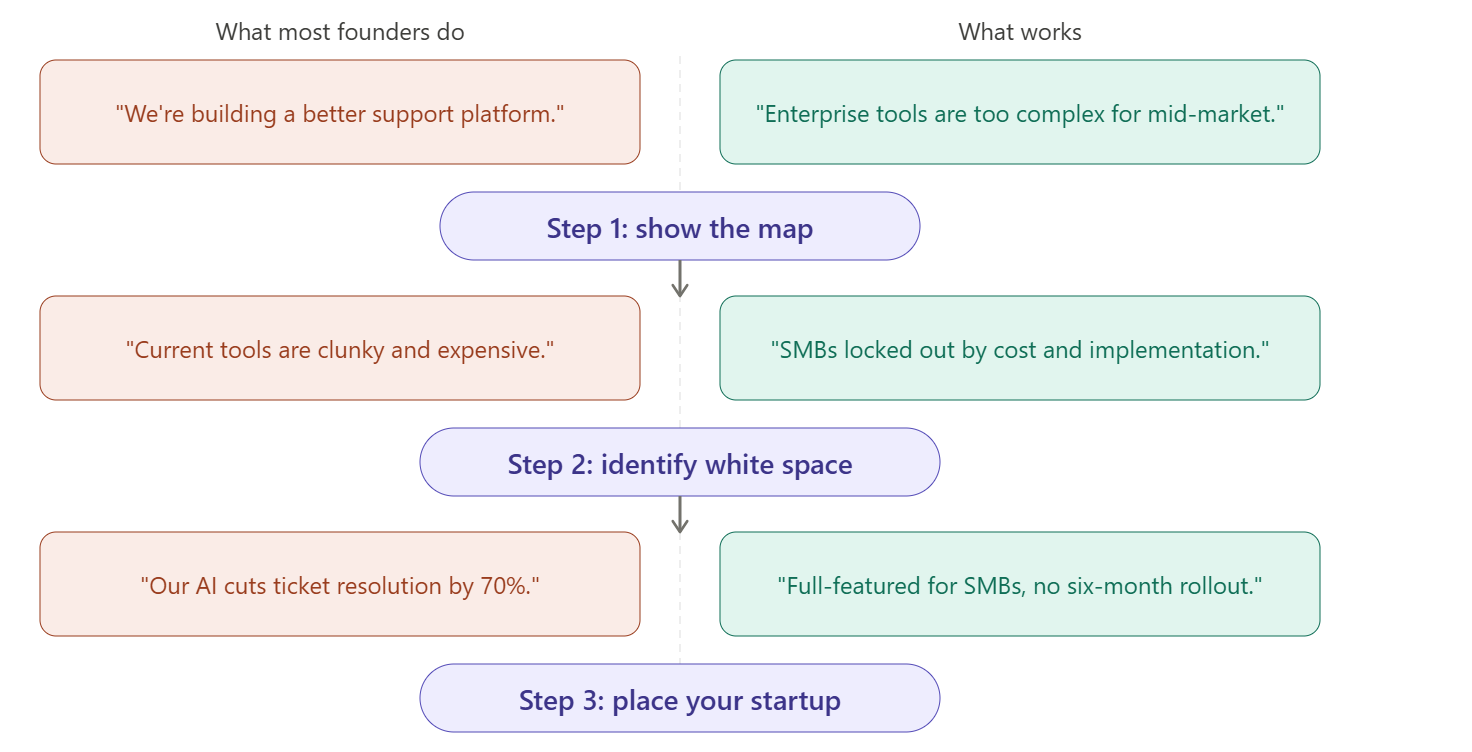
Step 1: Show the Market Map
Before talking about the product, describe how the market works today. Who are the existing players? How do customers currently solve the problem: software, spreadsheets, agencies, internal teams? Which segment is well-served and which is not?
A weak opening sounds like: "We are building a better customer support platform."
A stronger opening sounds like: "Customer support software has become powerful but also expensive and complex. Enterprise teams can absorb that complexity. Mid-market teams often cannot. They need automation and visibility, but without long implementation cycles or bloated workflows."
Step 2: Identify the White Space
Once the map is clear, show the gap. White space is not a vague complaint about incumbents being clunky or expensive. It is a specific opening: a segment being ignored, a pricing barrier locking out a large part of the market, an adoption problem making powerful tools useless in practice, or customers already working differently while old categories have not caught up.
The sharper the gap, the more credible the differentiation.
Step 3: Place Your Startup Inside That Gap
Only after showing the map and the white space should you bring in the product. By this point the investor is asking "how does this fit the gap you just showed me?"
Girish, while building Freshworks did not pitch a better help desk. He pitched a full-featured platform at a price point and UX that the ignored segment could actually adopt without a six-month implementation cycle. The product details answered a question the investor already had in their head.
The investor could follow the logic clearly: existing tools are too heavy and expensive for most of the market, mid-market and SMB companies need support automation without enterprise rollout effort, and this product is built specifically for that segment.
The Three Startup Differentiation Archetypes
Once founders learn to explain the market first, the next question becomes: what kind of differentiation story are you telling?
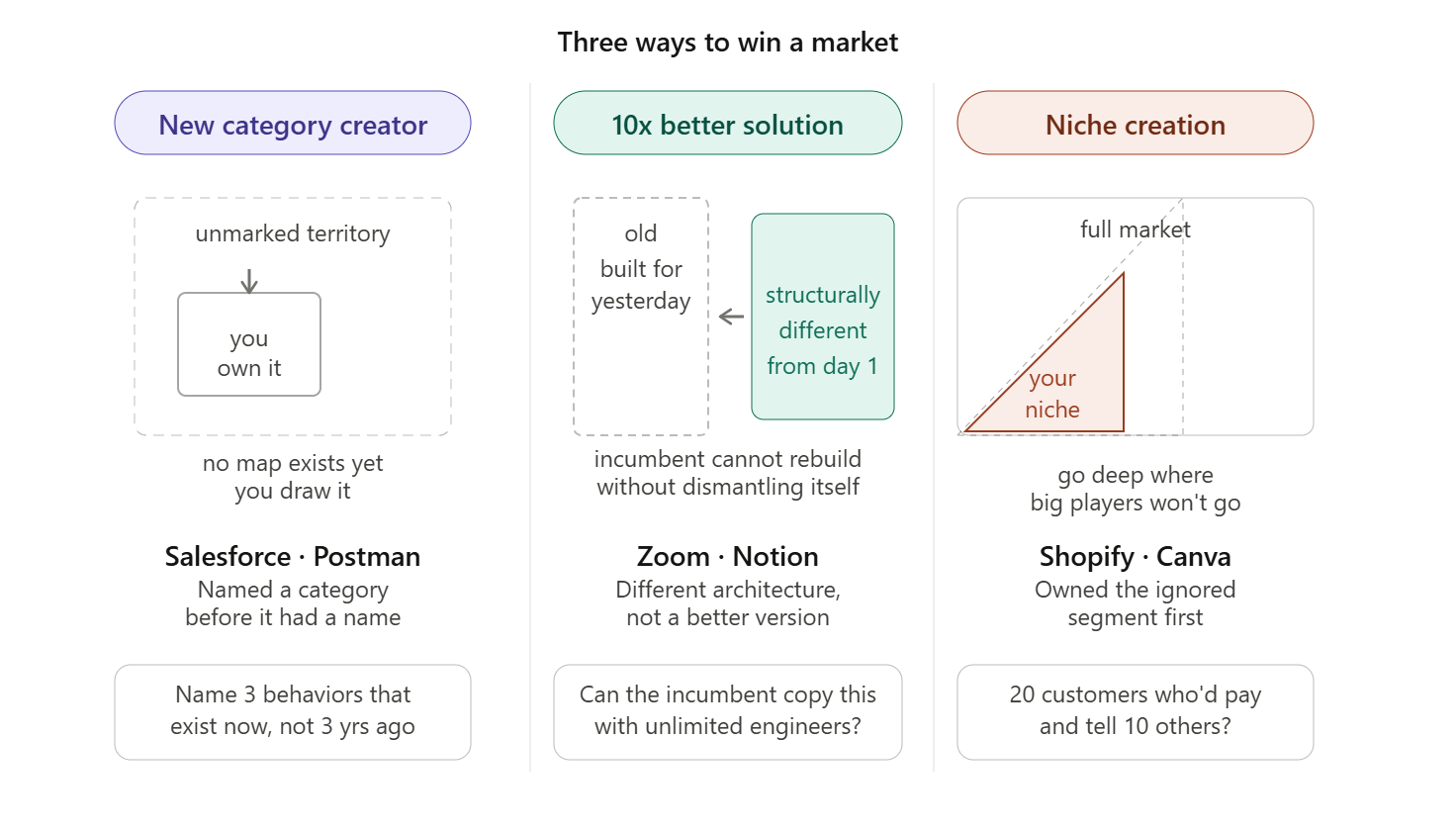
Some startups create a new category.
Some replace old tools with a structurally better solution.
Some go deep into a narrow segment that large players ignore.
These are three different stories with three different requirements for proof.
The mistake founders make is choosing the biggest-sounding archetype, not the most believable one. The right archetype depends on the market gap you identified.
Archetype 1: New Category Creator
A new category creator says "the way customers work is changing, and the old category no longer explains the problem." This is the hardest play but the biggest reward. What investors look for is evidence that a behavior shift is already happening organically, not one a startup is trying to manufacture.
While building Salesforce, Marc Benioff built the narrative that on-premise software was about to become structurally obsolete and that the internet was the unlock. The category did not exist. He named it, owned it, and made every competitor look like yesterday's infrastructure.
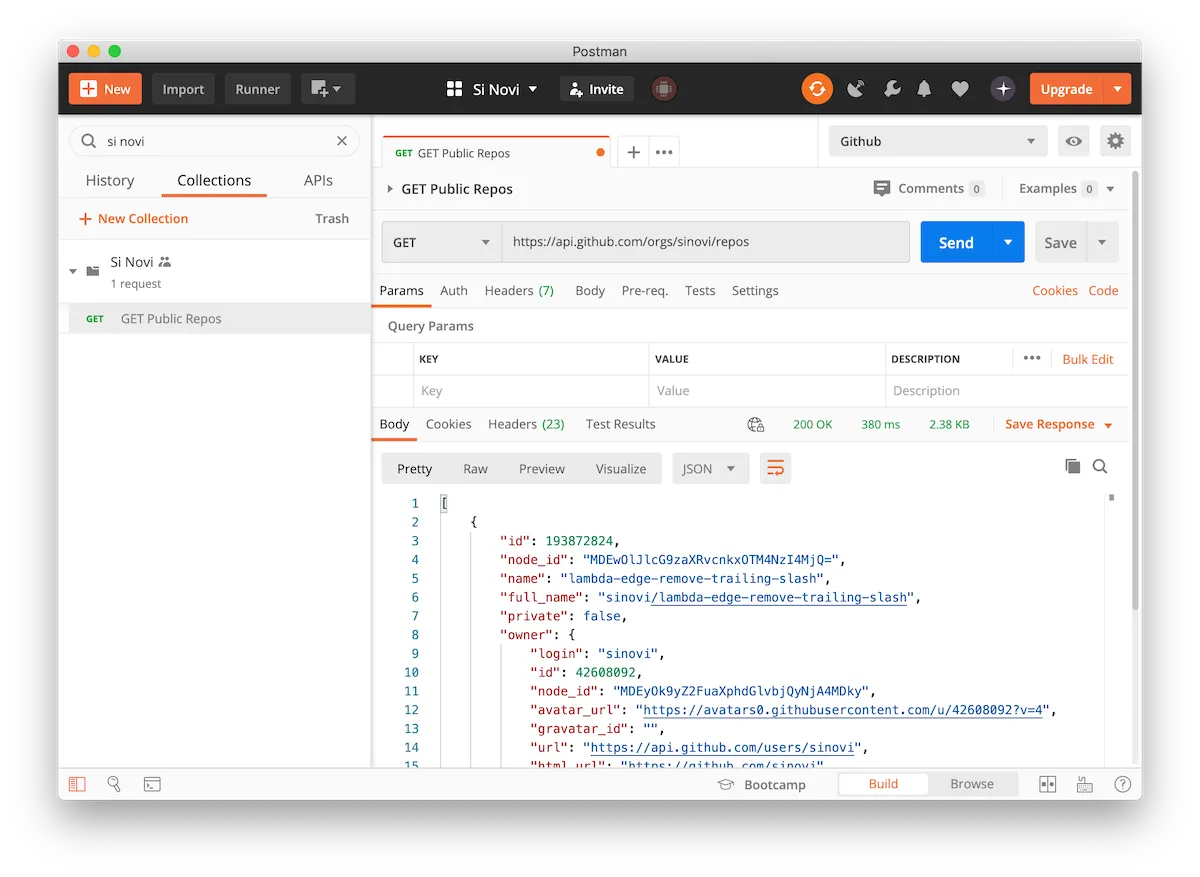
Abhinav Asthana did the same with Postman. Postman began as a Chrome extension for API testing. But as APIs became the primary way software teams built and connected products, Abhinav reframed the entire pitch.
Postman was not an API testing tool. It was the collaboration layer for teams building in an API-first world. That reframe changed how investors understood the opportunity. Postman is today valued at over five billion dollars.
Practical test: Can you point to 3 to 5 customer behaviors that exist today that did not exist three years ago? That behavioral shift is your evidence the category is arriving. If you cannot name those behaviors, you may be renaming an existing market rather than creating a new one.
Archetype 2: 10x Better Solution
A true 10x story requires proving that incumbents are structurally incapable of catching up, not just that you are better today. The investor's real question is: why can't the incumbent just copy this? If your answer is only "we move faster," the differentiation is weak.
For example, Zoom had a cleaner interface over Webex. But it was a fundamentally different approach to video infrastructure that made calls work reliably on poor connections. Webex's legacy architecture could not replicate this without a complete rebuild.
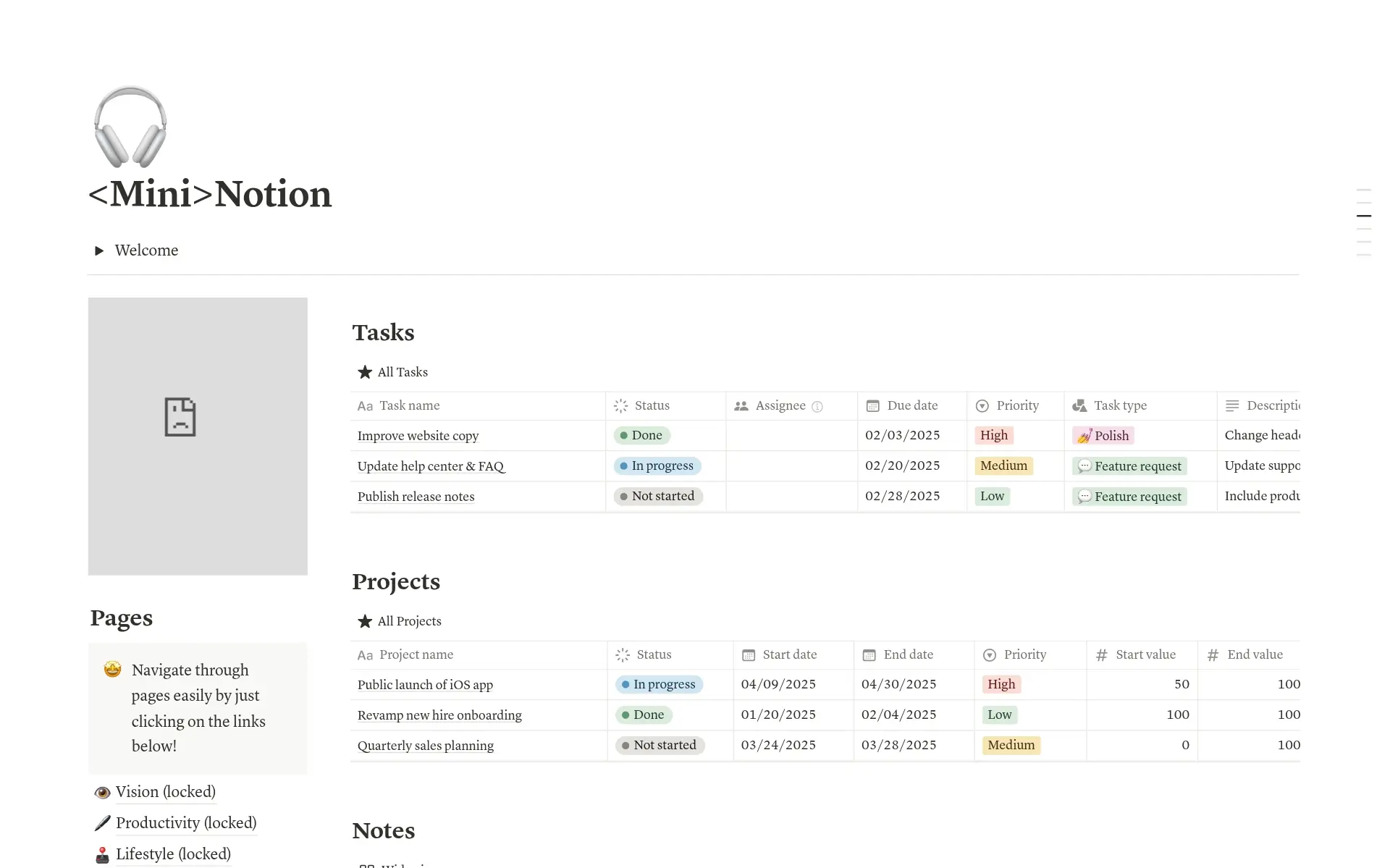
Notion versus Evernote tells the same story from a different angle. Evernote had the market, the brand, and the users. Notion introduced a mental model shift, treating content as flexible blocks and databases rather than static documents.
Evernote's core assumption became the exact thing Notion made look outdated. Copying Notion would have required Evernote to abandon its own product logic entirely.
Practical test: If the incumbent had unlimited engineering resources, could they replicate your advantage in 18 months? If yes, your moat is thinner than you think.
Archetype 3: Niche Creation
This is often the fastest path to defensibility for early-stage B2B startups. You are not claiming the whole market is changing overnight. You are saying a specific segment has been ignored, overcharged, or forced to use tools built for someone else. Large players see the segment as too small or too complex. That gives a startup room to build trust, own the niche, and expand later.
Shopify's founding story is the clearest example. Tobi Lutke was not trying to beat Amazon. He was solving for the snowboard shop owner who could not compete on Amazon's terms. By going deep on merchant empowerment for small businesses,
Shopify built the infrastructure and ecosystem that eventually made it the default for anyone wanting to own their commerce, not just the SMBs it started with.
Canva did the same. It did not attack Adobe Photoshop. It targeted the non-designer: the marketer, the small business owner, the teacher who needed professional-looking visuals but had no design training. Adobe's tools were built for professionals. Canva went deep on the segment Adobe never tried to serve. Once that niche was owned, expansion into more professional use cases followed naturally.
Practical test: Can you name 20 customers in your niche who would pay you right now and tell 10 others about you? If not, the niche is not sharp enough yet.
How Investors Decode Your Differentiation Slide
When investors look at your differentiation slide, they are trying to understand whether your company can become hard to ignore in a specific market. That is a much harder question to answer with a row of checkmarks.
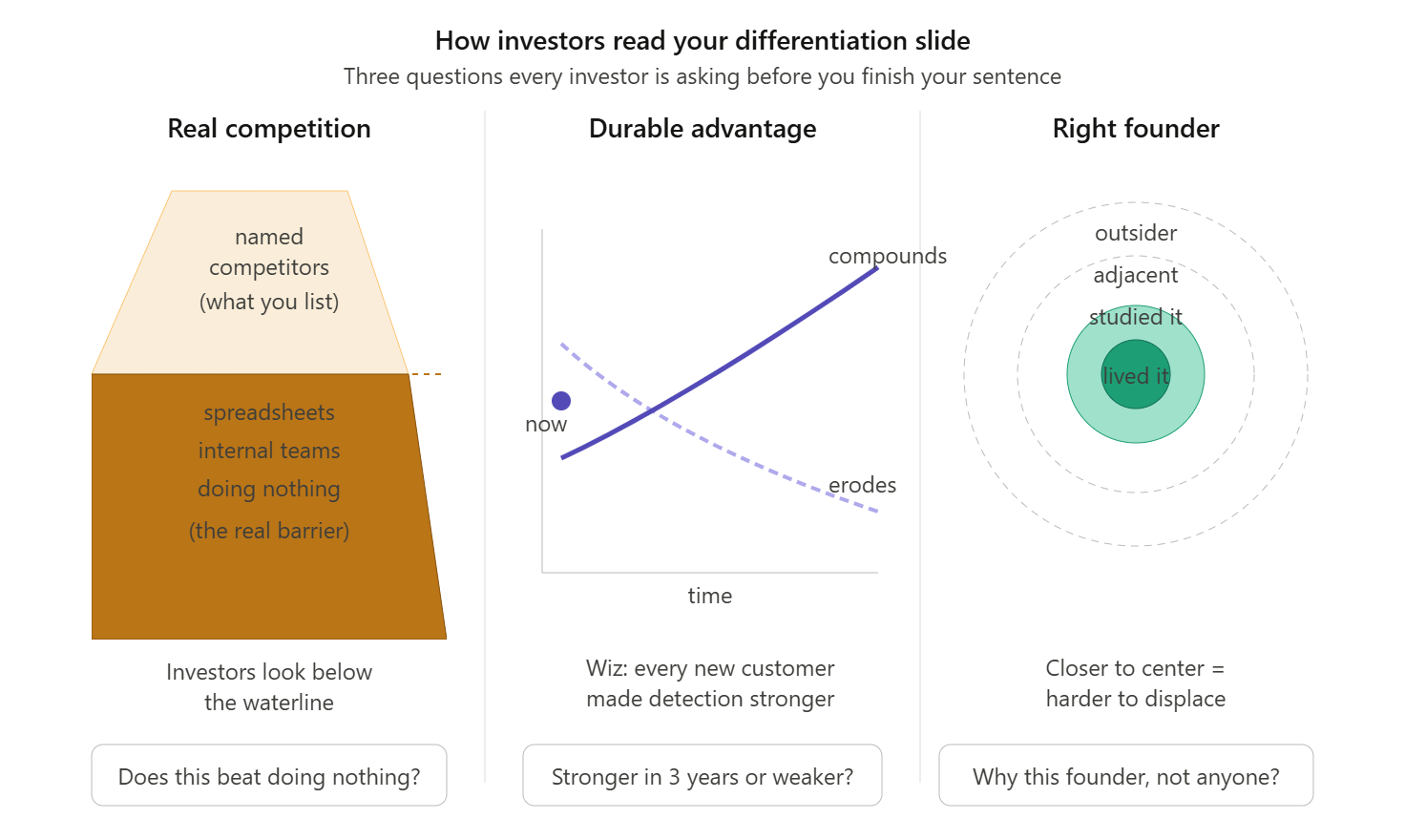
Investors decode differentiation through three lenses.
Lens 1: Do you understand your real competition?
Most founders list the obvious named competitors. But in many B2B markets, the toughest competitor is not another startup. It is a spreadsheet, an internal team, an agency, or the customer simply choosing to do nothing.
If you are building software for finance teams, your competition is not only other finance tools. It is also Excel, outsourced accountants, and the CFO's belief that "we can manage this manually for another year." That last competitor is often the hardest to displace because it requires no budget approval and no implementation risk.
If your differentiation only works against named software competitors, it misses the real buying barrier entirely.
Lens 2: Is your advantage durable or temporary?
Features, pricing, and ease of use can all be copied or undercut. Investors are looking for advantages that compound over time, not leads that disappear in 18 months.
Consider how Wiz grew in the cloud security market.Their agentless architecture meant every new customer deployment generated more signal, improving detection for the entire customer base. The more customers they added, the harder the advantage became to replicate. That is compounding strength.
When a founder says "our AI model is more accurate," the investor's follow-up is always: why can't someone else build the same model? The stronger answer explains why the data improves with every customer workflow, why that data is hard to access from outside, and why recreating the learning loop would take years of customer relationships.
Lens 3: Are you the right founder to own this position?
Investors know that a good market attracts competition. If the opportunity is real, others will enter. The founder's proximity to the problem is part of what makes the differentiation defensible.
A founder who can say "I spent six years running compliance operations for mid-market healthcare companies and watched the same manual vendor review process break across more than 40 audits" gives investors a specific reason to believe this team sees what others miss. It also answers a practical question: when a better-funded competitor enters, why does this founder still win?
Common Differentiation Mistakes Founders Should Avoid
Most differentiation mistakes happen because founders try to prove they are different before they have shown the investor why the market opening exists in the first place. The result is a pitch that feels feature-heavy, context-light, and hard to remember once the founder leaves the room.
Here are the most common ones to watch out for.
Mistake 1: Turning differentiation into a feature list
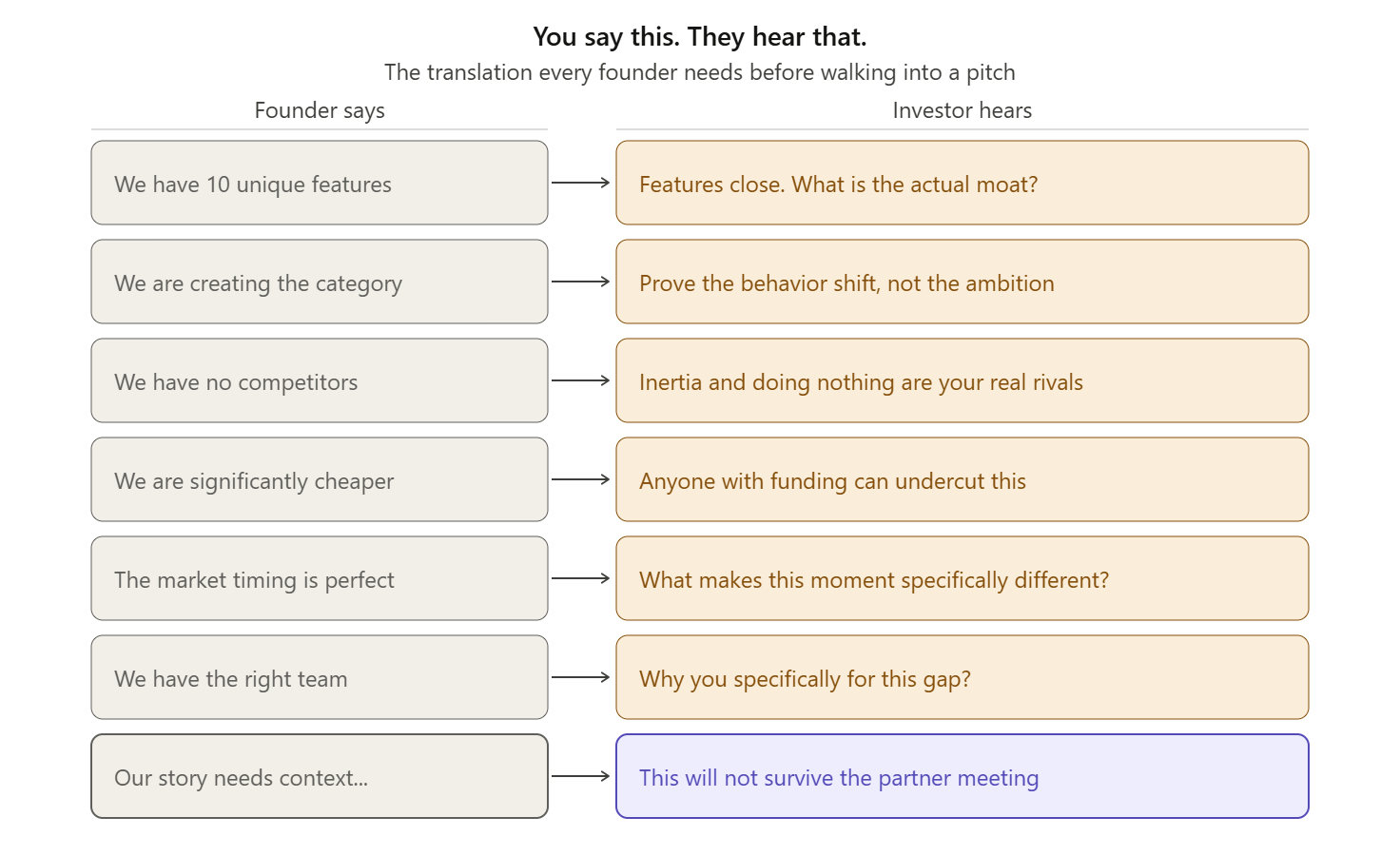
A comparison table with ten feature rows and all the checkmarks on your side looks convincing on paper. In practice it tells investors what your product does, not why your company can win. Investors know feature gaps close quickly. A missing integration can be built. A cleaner dashboard can be copied by any better-funded competitor within a product cycle.
Instead of saying "We have automated workflows, AI recommendations, analytics, and integrations", say "Mid-market teams need automation, but enterprise tools are too heavy and SMB tools are too limited. We built the product around the specific workflow gap these teams face every week."
The first version lists features. The second version explains why those features exist.
Mistake 2: Claiming a new category too early
A category claim without proof of changing customer behavior reads as overreach. Investors do not reward ambition alone. They look for signals that the shift is already happening: buyers searching for something that does not have a name yet, teams stitching together manual workarounds, existing tools being used for jobs they were never designed to do.
Without those signals, a new category claim sounds like a founder renaming an existing market to make the opportunity sound bigger.
Mistake 3: Saying "we have no competitors"
Every startup has competition. In B2B software, the most common competitor is not another product but the customer's decision to do nothing, stay on spreadsheets, or keep using an internal team. When a founder says "we have no competitors," investors hear that either the market does not exist or the founder has not studied how buying decisions actually happen.
A better answer is: "Most customers are still using spreadsheets and internal teams because existing tools feel too heavy. Our job is to replace that manual workflow first." This tells the investor you understand the real adoption barrier, which is more useful than a list of named competitors with fewer checkmarks.
Mistake 4: Competing mainly on price
Price alone can be undercut by any better-funded competitor at any time. It becomes a real advantage only when it comes from a structural reason: a self-serve product that needs no implementation team, a lighter support model, a more efficient distribution channel.
Freshworks could price below Zendesk not just because they wanted to, but because their product was built from the ground up for a segment that could not absorb long onboarding cycles or dedicated admin overhead.
Mistake 5: Ignoring the "why now"
A good market gap without a timing argument is just a good idea waiting to happen. Timing can come from a new regulation forcing workflow changes, an AI capability making a previously manual process automatable, or a buyer segment that has finally reached the scale where the pain becomes urgent enough to act on.
Girish Mathrubootham found his moment in a Hacker News thread where customers were furious about a price hike. The gap had existed before. The urgency was new. Without a clear "why now," differentiation feels like a solution looking for a moment.
Mistake 6: Forgetting the founder's right to win
A good market attracts competition. If the opportunity is real, others will enter. The founder's proximity to the problem, their customer relationships, and their domain depth are part of what makes the differentiation defensible over time. Many founders explain the market well but forget to explain why they specifically are the right person to own it.
Mistake 7: Making the story too hard to repeat
When an investor leaves your pitch, they carry one sentence into their partner meeting. Your differentiation story is that sentence. If it only makes sense when you are in the room, it will not survive the internal discussion.
A Simple Exercise to Sharpen Your Startup Differentiation
If your differentiation only becomes clear after a detailed demo, the story is too product-heavy. Investors need to understand the market logic before they see the product depth.
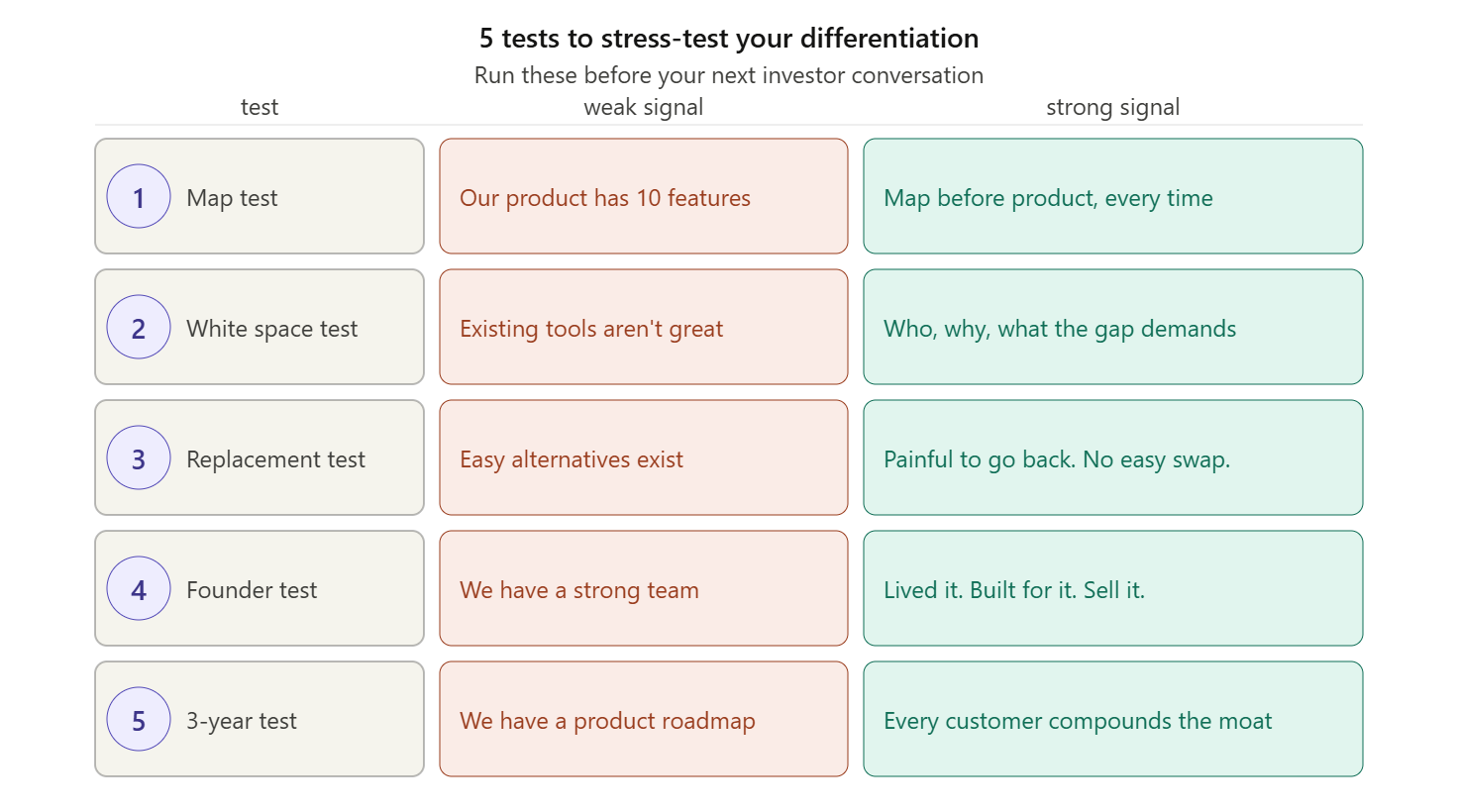
Use these five tests before your next investor conversation.
1. The map test
Can you explain the market landscape in two minutes before mentioning your product? You should be able to name the current players, describe how customers solve the problem today, identify which segment is well-served, and point to what has changed recently.
2. The white space test
Can you name the specific gap existing players are not solving? A vague gap sounds like: "Current tools are not user-friendly." A sharp gap sounds like: "Enterprise tools are built for large teams with dedicated admin support. Mid-market teams need the same workflow visibility without six-month implementation cycles." The second version tells the investor who is underserved, why existing tools fail them, and what kind of product the opening demands.
3. The replacement test
If your product disappeared tomorrow, what would your best customers use instead? This question reveals your real competition. In most B2B markets the honest answer is spreadsheets, an internal team, or simply doing nothing. If customers have an easy replacement, the differentiation may not be strong enough yet. If the answer is "they would struggle to go back because the old workflow was too painful," you have something worth defending.
4. The founder test
Why are you specifically the right person to build and sustain this differentiation? A good market attracts competition. The edge that lasts usually comes from lived experience, customer relationships built over years, or a view of the problem that an outsider would take years to develop. Make that edge explicit. It is part of the moat.
5. The 3-year test
Will your differentiation compound or erode? A feature advantage erodes. An advantage built on proprietary data, workflow lock-in, distribution, or deep customer trust gets harder to replicate over time. Shopify did not stay dominant in SMB commerce because of features. It stayed dominant because every merchant, app developer, and payment partner that joined the ecosystem made the platform more valuable for the next one. Ask whether your differentiation works the same way.
A strong startup differentiation story should answer 5 questions clearly:
Question
What It Proves
What is the market map?
You understand the terrain.
Where is the white space?
You see the opening.
What would customers use instead?
You understand real competition.
Why are you the right founder?
You have founder-market fit.
Why does this get stronger over time?
You have a path to durability.
Give Investors the Map Before the Pin
Before your next investor conversation, ask one question: are you giving investors the map first, or are you pointing to the pin too early?
If you start with the product, investors hear another feature claim. If you start with the market, the gap, and the timing, your product becomes the logical answer to a question the investor already has in their head.
When an investor leaves your pitch, they carry one sentence into their partner meeting. Your differentiation story is that sentence. If you cannot compress your position into something that travels without you in the room, the story is not ready yet. The founders who raise the fastest are not always the most differentiated. They are the ones who make the investor feel that their specific position in the market is the only logical one given the insight, the timing, and the customer truth.
If you are preparing for a fundraise and want to sharpen your positioning or investor story, talk to GTMXVentures. We help founders turn product depth into a clear market story that investors can understand, remember, and carry into partner discussions.
Frequently Asked Questions
What is startup differentiation?
Startup differentiation is the reason your startup deserves to win a specific market position. It includes your market timing, customer focus, product approach, founder edge, and long-term advantage.
Why does startup differentiation matter in fundraising?
Investors want to know why your company can win, not just why it can exist. A clear differentiation story helps them understand the market gap, why current options fall short, and why your startup is best placed to solve it.
What is the difference between product differentiation and startup differentiation?
Product differentiation explains what makes the product different. Startup differentiation explains why the company can win. It includes the product, but also covers market gap, timing, distribution, founder-market fit, and durability.
What should founders include in a startup differentiation slide?
A strong differentiation slide should cover four things:
Element
What It Explains
Market map
Who serves the market today
White space
What gap exists
Your position
Why your startup fits the gap
Defensibility
Why the advantage can last
What mistakes should founders avoid while defining startup differentiation?
Avoid turning differentiation into a feature list. Also avoid saying you have no competitors, claiming a new category too early, competing only on price, or ignoring the “why now.”
How can founders make their startup differentiation story stronger?
Start with the market, not the product. Explain what is changing, who is underserved, why current options fail, and why your startup is built for that gap.
Is lower pricing a strong startup differentiation?
Not by itself. Lower pricing works only when it comes from a structural advantage, such as faster onboarding, lower support needs, better distribution, or a more efficient product model.
How do investors judge if startup differentiation is durable?
They look for advantages that get stronger over time. This could include data, workflow lock-in, customer trust, distribution, community, or deep domain knowledge.
Saurabh Lahoti
Saurabh Lahoti is the founder of GTMDialogues, helping early-stage B2B startups scale with sharper GTM strategy, inbound marketing, and founder-led storytelling.

.png)






.png)

.png)

.png)

.png)



.png)



.png)
