Cracking the Hardest Sale You'll Ever Make: Your Fundraise
Aug 25
•
6
min read
Event-Led-Growth
Fundraising strategy
0 to 1 Stage
Pooja Baranigutta
A Founder Relations specialist focused on building meaningful connections and opportunities to support their growth.
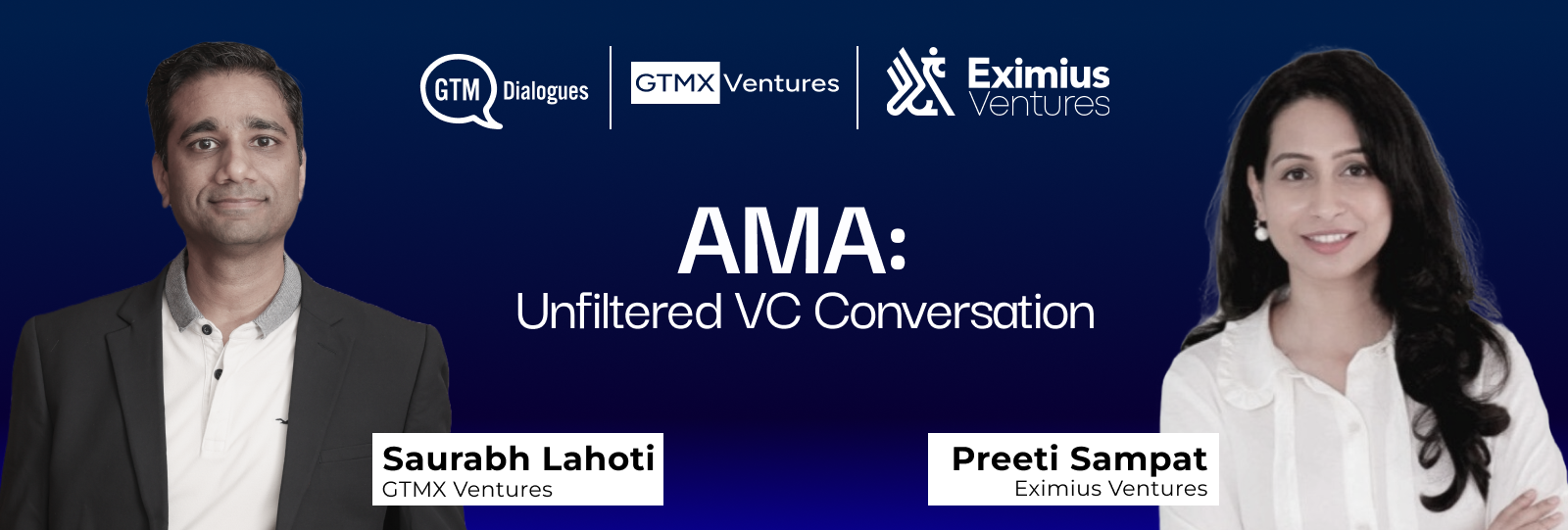
You have probably felt the sting of a VC going silent after a warm intro and three follow-up emails. GTMDialogues brought Preeti Sampat, Partner at Eximius Ventures, into an unfiltered AMA hosted by Saurabh Lahoti to unpack exactly why that happens.
Preeti has spent close to sixteen years split between operating roles, including building out Flipkart's live commerce business, and investing across the US and India. That mix shows in her answers: no diplomatic hedging, just the mechanics of how she filters hundreds of monthly pitches, what actually earns a yes, and why she has never once looked at a TAM slide.
This piece pulls together her sharpest answers on getting a VC's attention, what gets evaluated once you have it, and how to build defensibility when AI is making software cheaper to ship for everyone.
You're probably reaching out to the wrong investors, and that's why they're not responding
Preeti opens with the number that explains most of the silence: her fund alone sees over a thousand pitches a month. Response bandwidth simply cannot stretch that far.
Her diagnosis is direct, "I think a lot of it can be solved by homework," she says. Most founders spend two minutes on a partner's LinkedIn, generate a generic intro line, and send it to whichever fund shows up on a preseed list, regardless of fit.
She recommends building three tiers instead: > a P0 list of investors whose thesis matches you almost exactly, > a P1 list as a strong secondary fit, and > a P2 fallback. Reaching further than that just burns time better spent on the business.
Two of Eximius Ventures' investments came in as cold emails with no warm connection at all. When Preeti asked those founders how they built their list, it was just ten names chosen because the fit was obvious.
A first call is a filter for overlap between what you're building and what the fund invests in. Real evaluation starts at the second call, where founders bring sharp insights and early proof points to the table.
And the goal was never the call itself. Preeti's point is that founders often optimize for reaching more investors, when what actually matters is finding the right one. "The end result is to get an investment,and if you get an investment, it's not just an investment, because our value goes beyond financial capital." The right fund brings a partner, not just a check, which is exactly why the P0 targeting matters more than the volume of names on your list.
When Eximius Ventures decides to say yes, here's what's actually being evaluated
Saurabh pushes past the surface-level version of this question: everyone says they value founders and markets, but what does that actually mean in practice?
Preeti's answer is that both require the same discipline: going several layers deeper than most people stop at. When she looks at a market, she doesn't just check if it's growing. She works it from both directions, starting with what's happening on the ground and matching it against where the category is headed globally, then checks whether the founder's own experience actually connects to that shift.
The same depth applies to founders. Eximius benchmarks execution ability, learning speed, customer quality, and how founders respond to competition and market shifts, not just in India but globally. She sees this as a mirror of what founders should already be doing for themselves: sizing up their own team, network, and traction against the strongest players in their category, instead of assuming a good market alone will carry them.
There's also a practical reason for the rigor, every investment has to answer to the fund's own capital providers, which means Eximius is comparing each opportunity not just against local competition, but against the best version of that business anywhere in the world.
How an investor’s pushback can become your comeback pitch
Saurabh names the terms every founder has heard thrown around in pitch feedback: execution bias, resilience, coachability, storytelling. The question underneath is whether VCs are judging these on gut feel or something more concrete.
Preeti reframes the entire idea of storytelling: it's about walking into a conversation with evidence, not just a narrative, delivery or polish. If an investor raised a concern in a previous meeting, the founder's job in the next one is to show, with data, why that concern no longer holds.
She backs this with a real example. One company came to Eximius's investment committee and didn't get funded on the first pass, largely on the strength of a few unresolved questions. Over the next two months, the founders took the feedback directly, tested the pieces the fund had doubted, and came back with proof. A second investment committee meeting followed, and this time, the deal closed.
That gap, just over two months, is the point. Resilience and coachability aren't traits an investor senses in the room. They show up as a founder's willingness to act on feedback and return with something different, instead of just a repeated pitch with more confidence behind it.
Preeti's advice for founders preparing for these conversations is to treat every claim as something that needs backing. If you're arguing the market is sticky, show retention data. If you're arguing you can move fast, show what changed between two conversations with the same investor. The story only works if the evidence carries it.
Why Preeti has never once looked at a TAM, SAM, or SOM slide
Saurabh raises a scenario every early founder in a new category faces: how do you size a market that hasn't fully formed yet, especially when the current numbers look small but the category is expected to expand fast?
Preeti's answer cuts against what most pitch decks assume. She has never based a decision on a TAM, SAM, or SOM number, and she doesn't think most investors genuinely do either. Market sizing, in her view, is a fluid concept, more so now, as AI reshapes what a category even means and multiple companies attack the same problem from different angles.
Her alternative approach starts with competition instead of a market-size slide. If competitors already exist, she wants to see how they segmented the opportunity, whether it's a substitute market, an expanding one, or something adjacent that hasn't been fully claimed yet.
If it's a genuinely new category with no direct competition, the founder's job shifts to showing how they're breaking the opportunity into pieces the investor can actually evaluate, rather than pointing at one large number.
The goal is to help the investor understand the shape of the opportunity: where the near-term revenue sits, where it could expand, and why that direction makes sense given what's happening globally in the category.
AI is killing the technical moat, so what actually makes a company defensible now
AI is making it cheaper and faster to build, which means the old idea of a technical moat is eroding. Buyers increasingly ask why they should pay for a product when they could build a version of it in-house.
Preeti's response to this starts with an admission. Eximius has stopped asking founders about proprietary technology as a defensibility factor, because building intelligent software simply doesn't cost what it used to. Instead, she looks at four things:
Owning the customer. How deeply you understand them and how well you can execute for them, even in a crowded market.
Owning the workflow. Whether your product is embedded in how a team actually works, not just a tool they open occasionally.
The founding team itself. How adaptable, ambitious, and innovative the founders are when the market shifts underneath them.
Distribution. If you already have a way to reach customers efficiently, growth compounds faster than a competitor starting from scratch.
She illustrates the founding-team point with an example from her own portfolio: a founder who is also the product's primary support engineer, sitting directly with customers to fix workflow issues and feeding that feedback back into the product himself. That willingness to play every role, she says, is its own form of defensibility.
Her closing point is that, even the best product in a category will have two or three strong competitors globally. What decides the winner is how fast the team moves and how well they prioritize under pressure.
Across every question Saurabh asked, whether it was about getting a first meeting or building a defensible company, Preeti's answers kept returning to the same underlying habit: do the work before you ask for anything. Target the right investors instead of the most investors. Bring evidence instead of a polished narrative. Understand your market's real shape instead of a slide with one large number on it.
None of this is complicated advice. It's also, by her own account, the exact thing most founders skip. If there's one takeaway to carry into your next investor meet, it's that the homework itself is the pitch.
Pooja Baranigutta
A Founder Relations specialist focused on building meaningful connections and opportunities to support their growth.

.png)



.png)

.png)


.png)

.png)


.png)

.png)
