.png)
Fundraising
What Arali Ventures Looks for in Pre-Revenue Founders
Aug 5
•
13
min read
0 to 1 Stage
Event-Led-Growth

A Founder Relations specialist focused on building meaningful connections and opportunities to support their growth.

A Founder Relations specialist focused on building meaningful connections and opportunities to support their growth.
If you have ever walked into a VC meeting with a deck but no revenue, you might know the feeling that follows. Most investors will hear you out, nod along, and ask you to come back when the numbers look better. It is a polite way of saying the door is closed, at least for now.
Arun Raghavan has spent the better part of fifteen years on the other side of that table as a VC, and now as co-founder of Arali Ventures, a seed-stage firm built on a fundamentally different premise. Arali goes in before revenue, before the product is fully built, and sometimes before the market even has a name for what the founder is trying to solve.
In a recent GTMDialogues Deep Dives AMA, Arun spent over an hour in an unscripted conversation with founders from across the enterprise tech and deep tech space.
What emerged was a way of thinking about conviction, about timing, and about what separates a genuine "yes" from a soft defer. This piece walks you through the ideas Arun shared, grounded in the real examples from his own portfolio, so you can stop chasing the wrong signals and start building a story that actually sticks.
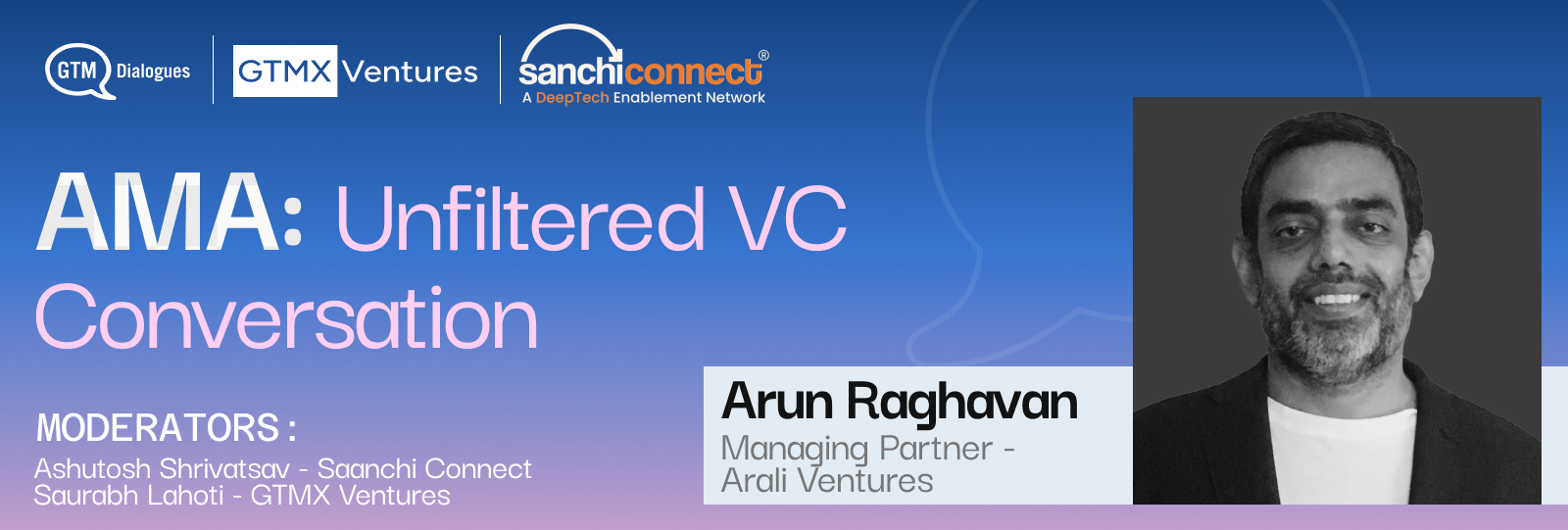
When Arali started, the gap in the enterprise tech investing landscape was easy to see but hard to act on. Capital was available for companies that had crossed certain proof points, revenue, early customers, something tangible to point at. What was missing was a firm willing to go in before any of that existed.
Arun said, "There was not a lot of capital that was going in at the seed stage into Enterprise technology companies. There were guys who were willing to cut a larger check once there was some visibility." Arali's response to this was to occupy the stage that everyone else was waiting out.
This positioning decision changed what Arali had to become genuinely good at: If you cannot ask for revenue or product validation as proof, you have to build a different kind of conviction, one built on people, problems, and market timing rather than numbers.
The fund's tagline, "It's never too early to speak to Arali," reflects this structurally. As Arun put it, "You can't afford to go back and say, come back to me with a million dollar ARR and I'll cut the seed check. It doesn't work anyway." A seed fund that waits for visibility is a smaller Series A. Understanding this changes how you should think about approaching Arali and investors like Arun.
Arun is upfront that there is no formula. "If there is a formula, then everyone else would do it," he said. But across six to seven years of investing at the pre-revenue stage, three things consistently shape how conviction forms, and understanding them changes how you build your story.
The first thing Arun looks for is if you have a take on that problem that only someone who has lived it from the inside could have.
He used HBOX as an example during the session. HBOX was building digital infrastructure for specialty clinics, virtual care, online appointments, remote consultations. That category already existed when they started, but what stood out was the depth of thinking the founder had brought to a narrow slice of it.
The founder had mapped exactly why a cardiologist and a nephrologist need something fundamentally different from what a general practitioner uses, and that level of specificity was what caught Arun's attention.
Before you walk into any investor conversation, ask yourself what you know about this problem that someone who has only read about it would not know. If you cannot answer that clearly, the problem statement is not ready yet.
The second thing Arun watches for is what is actually driving the founding team. He is careful to say that multiple motivations can coexist, but there is one distinction he pays close attention to.
He is looking for whether the person in front of him is thinking about building a company or just solving an interesting technical problem. Both can produce strong work, but only one of them becomes an investable business at the seed stage.
If you are a technical founder, the question to hold before every investor conversation is whether you can talk about your company as a business with the same fluency you use when talking about the product.
The third factor is timing, which Arun treats as a variable separate from market size. A large market that is not ready to pay today is a very different investment from one that is actively looking for a solution right now.
He pointed to Indian B2B healthcare as an example of a market that is real but not yet at an inflection point. The technology is ready and the problem is well understood, but the willingness to pay at the levels that make it an investable business has not arrived for most categories within it.
If your market falls into this position, the question you need to answer is not just whether the opportunity exists, but whether you can build efficiently enough to still be standing when it does.
One of the most consistent threads across Arun's portfolio conversations is a simple but uncomfortable question he asks every founding team: what is the one thing you are going to focus on? Not what you could build, not what the platform will eventually become, but what you are going to solve first, well enough for someone to pay for it.
His logic is direct. "When you are a 15 member team. You cannot build and sell more than one solution." The temptation at the early stage is to stay broad, to hedge against the possibility that one thing does not work by building five.
When you go into an enterprise, they already have around 150 solutions in use. What gets your foot in the door is a very specific answer to a very specific problem they have not been able to solve well. As Arun put it, "Is there one small point problem that you can solve ten times better than whatever they have? That is what I would go back and look at."
The most instructive part of the session was Arun explaining the examples from his own portfolio that showed how it plays out in practice.
When FinBox started, the team came in with three or four product options they believed would resonate with NBFCs. They had done their research, built prototypes, and had a clear view on which ones would land.
When they had real conversations with those NBFCs, none of those options were the ones that generated serious interest. "It turned out that the fifth one, which was not there on the drawing board, was the one that eventually caught a lot of interest," Arun said. HBOX followed the same pattern, cycling through three or four solutions before the fifth or sixth finally got traction.
Two things stand out from both examples:
Changing your wedge after early customer conversations can feel like backtracking. Here is how to think about what you hold versus what you stay open about:
There is one more piece of discipline Arun comes back to on this: "Assume that the next round is not going to come and think like that when you're building this business." The wedge you commit to should be something that can generate enough early proof to keep you running, because the funding environment six to twelve months from now may look nothing like it does today.
Almost every founder in the session had a version of the same story. They had pitched multiple investors, received polite responses, and been told to show more growth before the conversation could move forward. It is one of the most common experiences in early-stage fundraising, and one of the most misread.
Arun decoded it by saying, "The easiest thing for the VC to say is come back with more traction, that means that he is not genuinely thinking about investing today." It is a soft exit from a conversation the investor has already decided to leave.
A VC who is seriously considering your company will do at least some of the following:
If none of that is happening, the polite response is already a no. Seed funds like Arali receive upwards of 60 to 70 emails a day and are looking for one company a month to back. Silence is not necessarily a reflection of your business, it is just the math of how early stage investing works.
The right response to a soft defer and ask yourself three things:
One of the founders in the session raised a question that most early-stage builders are sitting with right now: if anyone can build a competing product in a matter of weeks, where does defensibility actually come from? Arun's answer was direct and worth taking seriously.
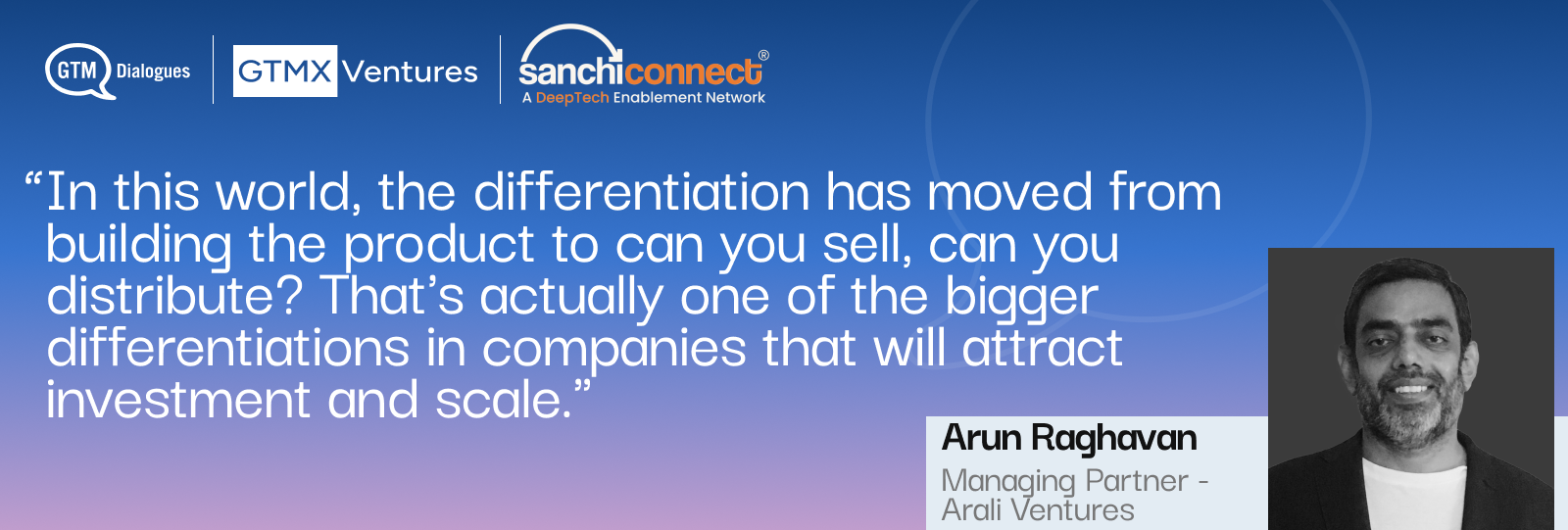
What is genuinely hard to replicate is a sales motion that works, a distribution channel built on real relationships, and a customer success function that makes people renew and refer. These take time and deliberate effort to build, and they compound in ways that a competing product cannot easily undo.
On the question of AI specifically, Arun drew on an analogy from his own career that reframes how to think about this. When SAP and Oracle were rolling out in the late 1990s and early 2000s, the same question was being asked: if the ERP system becomes powerful enough, why would anyone pay for implementation services? 30 years later, the answer is clear.
"Even if the models are powerful, can an insurance company sitting in the Midwest in the US, a commercial insurer, have the capability to use the model and build the software himself?" The answer, in almost every enterprise context, is no. And that gap is where vertically focused AI companies live.
What an enterprise actually needs from any technology it adopts goes well beyond the raw capability of the underlying model:
As Arun said, "Who will deliver the final solution, final service to the client is the most important thing that people forget to ask." Foundation model providers are not going to walk into a Bank of America and implement a risk management system. That last mile is where the business lives.
This is why Arali's thesis on AI has consistently favored verticalized solutions over horizontal plays. "The more verticalized the solution, the better you are than the model because you have more contextual data, your data is getting better, and you are actually plugging the final mile in terms of delivering value to the client." The outcome you are delivering is not a productivity percentage. It is a result the client can see and measure.
The practical implication for you as a founder is this: if your entire competitive position rests on the quality of your model or your product, you are building on ground that shifts with every new release. If your position rests on how deeply embedded you are in a specific workflow, how much domain data you hold, and how reliably you deliver a specific outcome for a specific customer type, the next GPT release is not an existential threat. It is just a better engine for doing the same job.
Several founders in the session were caught in a position that Arun hears often: they needed capital to build a specific feature that would close an enterprise customer, but investors were waiting to see revenue before they would write a check.
Arun's suggestion for founders stuck in this position is to go back to the customer who wants the feature and tell them you will build it, but only if they are willing to put something on the table first. An LOI, a small upfront payment, or even a commitment to pay on delivery turns a stalled conversation into a customer funded development agreement. It is not the most glamorous path, but it is how a lot of durable companies got their first product built.
This approach is how many durable companies got started. The services revenue pays the bills, the product gets built with a paying customer already in place, and you go back to investors with a much stronger story than you had before. Arun noted that separating the two businesses later, once the product has legs, is entirely doable.
Arun pointed to a robotics company from Pune as an example that spent years trying to crack the domestic market before finally finding its biggest customers abroad. The reason it struggled in India had nothing to do with the quality of the product.
It came down to a simple economic reality: when the cost of human labor is low enough, the case for automation does not make itself. The companies that eventually paid for the solution were in markets where that cost equation looked completely different, and that is where the business finally found its footing.
Three things to consider if you are in a similar position:
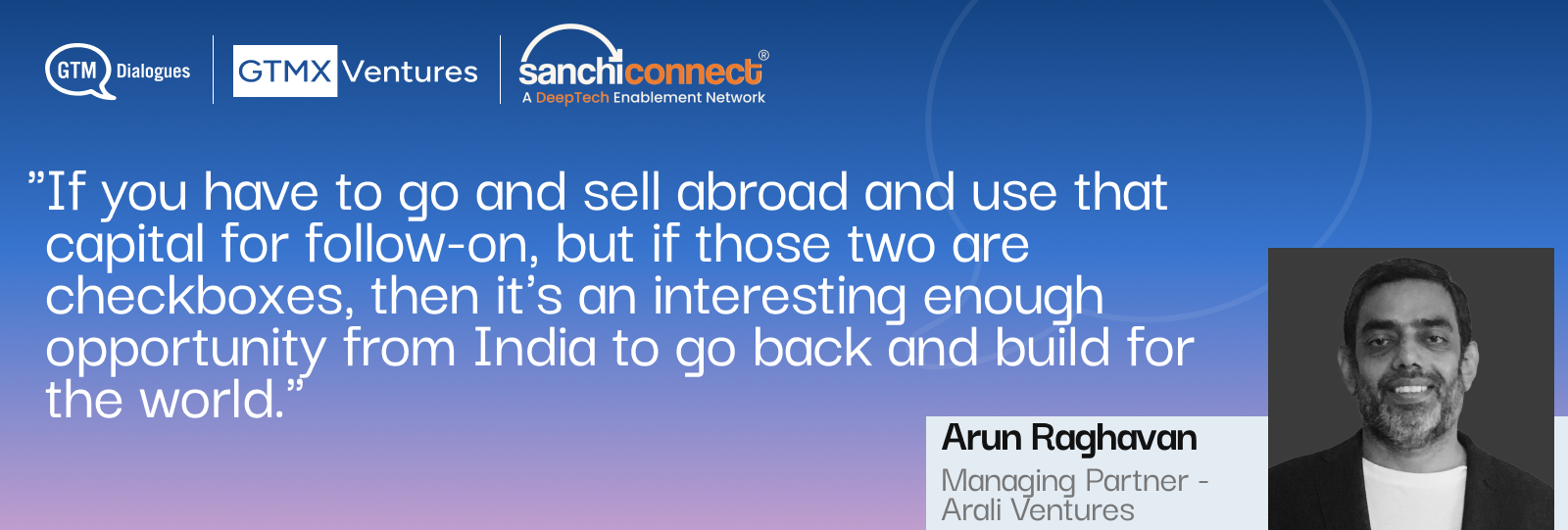
Everything Arun shared in this session points to one consistent truth: the founders who get funded at the pre-revenue stage are the ones who understand their problem at a level nobody else has reached, who are building a business and not just a product, and who are honest enough about market timing to plan for survival rather than depending on a check that may never come.
The wedge they start with is rarely the one that works, but the willingness to stay in the problem long enough to find the right one is exactly what separates the companies Arali backs from the ones they pass on."
Yes, and that is by design. Most of Arali's investments have gone into companies at the pre-revenue or very early revenue stage, sometimes before the product is fully built. The fund was specifically structured to fill a gap that most institutional capital leaves open. Going to Arali and being asked to come back with a million dollars in ARR would defeat the entire premise of what the fund does.
Arali has been investing from its current fund since 2023 and is near the tail end of that deployment cycle, with a couple of investments remaining. A new fund of approximately 65 million dollars is expected to be operational from October 2026, which means there will be a period where both fund structures run in parallel.
A first check is typically around one million dollars. Arali also has the ability to follow on at two to three times that amount in companies where conviction builds over time. The fund focuses exclusively on enterprise tech at the seed stage, so if your company falls outside that definition, it is worth clarifying fit before investing time in the process.
The formal cadence is once a month, but in practice the engagement is much more frequent. Arun described it this way: "There is a WhatsApp channel with each founder. Invariably there is a discussion once every week or two weeks with most founders." The nature of the involvement is more advisory than operational. As Arun put it, "We let the founders decide and run their business because ultimately it is their business to run. I am a 20% shareholder at best." The conversations tend to focus on which opportunities to prioritize, how to think about capital allocation, and when to bring in outside expertise for specific problems.
Not without something materially different to show. As covered earlier in this piece, that response usually signals the investor is not actively tracking your company. Continuing to follow up with the same pitch rarely changes the outcome.
The more productive move is to find a warmer introduction path into that fund, sharpen the framing of your opportunity, or redirect your energy toward investors whose stated thesis is a closer match to what you are building.
It depends on where the market is genuinely ready to pay. The caveat is that international markets are more competitive and require a different GTM approach. But if the domestic value proposition is structurally weak due to cost economics or low adoption readiness, going international early is a legitimate path, not a fallback.

A Founder Relations specialist focused on building meaningful connections and opportunities to support their growth.

.png)

.png)
.png)

.png)


.png)
.png)
