Differentiation Story for Investors: How to Stand Out in a Pitch Deck
Oct 6
•
6
min read
Fundraising strategy
Saurabh Lahoti
Saurabh Lahoti is the founder of GTMDialogues, helping early-stage B2B startups scale with sharper GTM strategy, inbound marketing, and founder-led storytelling.
Investors forget most decks within a day. The one they remember answers a single question in one breath: why you, and why nobody else? That answer is your differentiation story.
Many founders respond with a feature list or a competitor grid full of green ticks. Investors fund a position that a company can own and defend. Peter Thiel's essay Competition Is for Losers argues that the best companies escape head-on competition by being different enough to set their own rules.
Venture investors look for the same thing. Sequoia's business plan guide asks founders to name their direct and indirect competitors and to show a plan to win. Greylock's Reid Hoffman has long advised founders to be contrarian and right. A differentiation story is the proof of both.
Three Ways to Differentiate, and Why Investors Back Only One per Deck
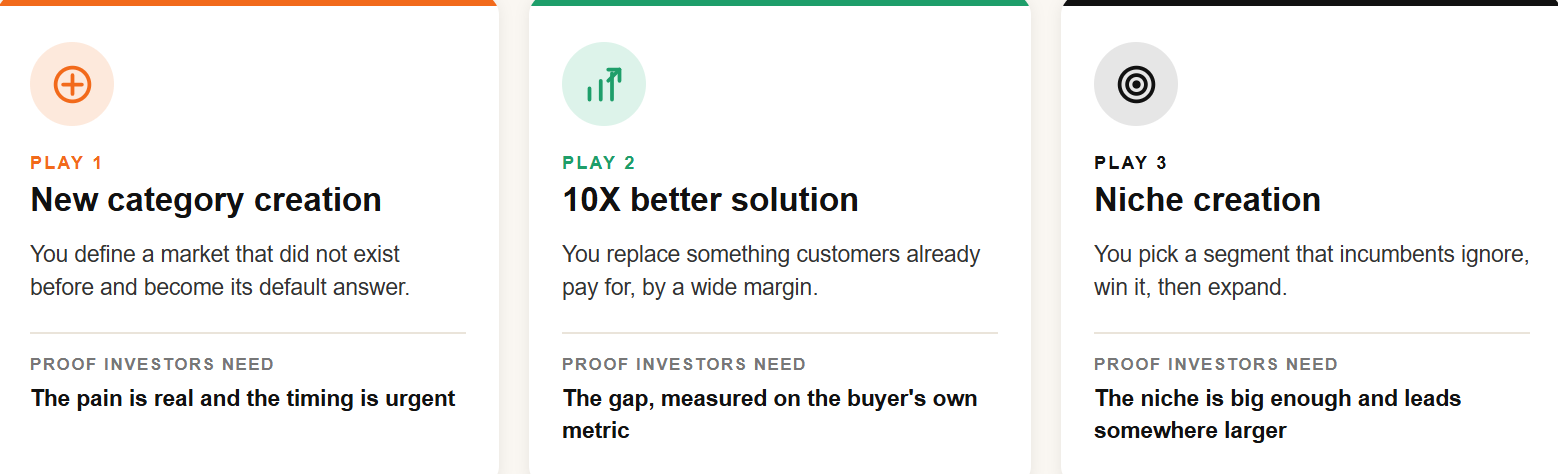
Nearly every durable position comes from one of three plays. Each asks investors to believe something different about your company, so each needs its own proof and its own slide.
New category creation: You name a problem customers did not know they had, then become the default answer. The upside is the largest of the three plays, and the cost is educating the market before you can sell to it.
10X better solution:The market already exists and budgets are already allocated, so the job is to make switching feel obvious. You get there by beating the current fix by a wide margin on a metric the buyer pays attention to.
Niche creation: You enter a big, competitive market through a door incumbents left open, such as a segment they underserve, overcharge or ignore. You win on focus first and expand from there.
A deck that claims all three convinces no one. Choose the play that matches your customer reality and build the whole deck around it.
How to Pitch a New Category to Investors: The Proof You Need Before You Sell the Product
Salesforce launched in 2000 with a "No Software" campaign that framed installed enterprise software as obsolete. Gainsight named customer success and built the category through its Pulse conference, which grew from 300 attendees in year one to 23,000 virtual attendees, and through three books on the subject. Postman began as a Bangalore side project, then repositioned as "the API platform for an API-first world" and is now used by 500,000 companies.
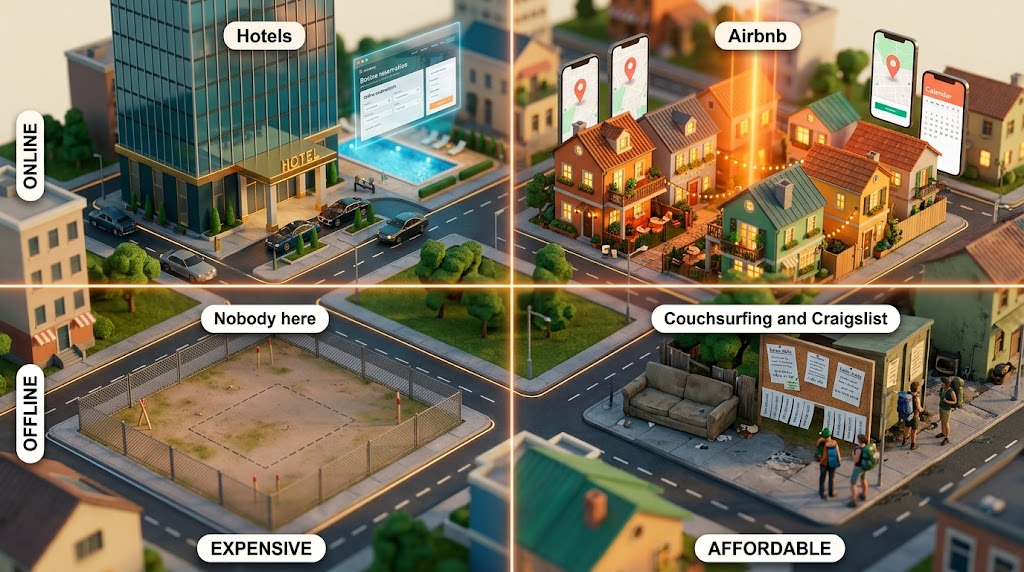
Airbnb's 2008 seed deck raised $600K and carried a 2x2 of affordable against expensive and online against offline. Hotels sat in expensive and online, Couchsurfing and Craigslist sat in affordable and offline, and Airbnb stood alone in affordable and online.
LinkedIn's 2004 Series B deck to Greylock lined up eBay, PayPal and Google as network businesses, then placed the professional network in that line.
What Investors Test Before Backing a New Category
Is the pain real even if nobody searches for it yet? A new category has no search volume or budget line to point to, so investors look for behaviour instead of opinion. Workarounds such as spreadsheets, manual processes and homemade hacks show that customers already pay for the problem in time and effort.
Can you fund the education cycle? Before anyone buys in a new category, the company has to teach the market that the problem exists. That teaching costs money in content, events and community, and it comes long before revenue, so investors check whether your runway can carry it.
Does the timing make sense today? Sequoia's business plan guide asks why your solution has not been built before now. A strong answer names what changed, such as a technology, a regulation, a price shift or a new behaviour. Gainsight's sequence works as a deck script: why anything, why technology, why now, and only then why us.
How to Pitch a 10X Better Solution So Investors See Switching as Obvious
A 10X better solution enters a market where budgets already exist, so investors ask one question: will customers switch? Peter Thiel's Zero to One sets the bar at proprietary technology that is at least 10 times better than its closest substitute on an important dimension. Anything less and inertia wins.
Kunal Shah of CRED gives Indian founders a sharper test in his Delta 4 theory. Rate the old way and your way on efficiency out of 10, and a gap of 4 or more makes the switch irreversible. Ordering food by phone scores about 3 and Swiggy scores about 9.
Zoom followed this logic. Eric Yuan left Cisco in 2011 after he did not see a single happy customer of its WebEx product, and Zoom reached about 3,500 businesses within five months of its 2013 launch.
Zerodha launched in 2010 with a flat fee of at most ₹20 on futures, options and intraday trades while traditional brokers charged a percentage, and by 2020 it handled 15 percent of India's retail trading volume.
The strongest slides show the gap without a comparison grid. UberCab's 2008 deck framed its offer as pressing a button on your phone so that a car appears within minutes. A before and after slide works the same way: the status quo metric on the left ("12 days to reconcile"), your product on the right ("4 hours"), and one customer logo as proof.
What Investors Test Before Backing a 10X Solution
Is it 10X on a metric the buyer pays for? Faster, cheaper or easier only counts when it moves the buyer's P&L or workflow. A large gain on something the buyer never tracks earns no budget.
Is the gap proven? Pilot data, customers who churned from a competitor and win rates against the incumbent carry more weight than a claim on a slide.
Will the advantage last? If an incumbent can copy it in two quarters, it is a feature and carries no moat. Investors ask what stops a rival from matching you, such as proprietary technology, data or distribution.
How to Pitch a Niche Market to Investors as a Wedge Into a Larger Business
Niche creation enters a big market through a door that incumbents left open. Paul Graham of Y Combinator reduces the logic to one line in Startups in 13 Sentences: "Better to make a few users love you than a lot ambivalent."
Freshworks is India's best-known niche play. In 2010 Girish Mathrubootham read a Hacker News thread about Zendesk raising its prices by 60 to 300 percent, then built Freshdesk for the small and medium businesses that Zendesk left underserved. The company hunted deer instead of elephants, and it became India's first SaaS unicorn.
Veeva, founded in 2007, built CRM only for life sciences on top of Salesforce's own platform. By 2019 it served 47 of the top 50 pharma companies with about 80 percent share of its niche. Canva's founder Melanie Perkins, a former graphic design tutor, saw how slowly users learned traditional design tools. She tested the idea first with Fusion Books, a school yearbook editor, and by April 2025 Canva had 230 million users and $3 billion in annual revenue.
Intercom's 2011 seed deck sorted 16 competitors, including Zendesk, MailChimp and Mixpanel, into four silos: social media research, customer feedback, email campaigns and user analytics. The slide argued that SaaS founders stitch four tools together today and that Intercom replaces the stack.
What Investors Test Before Backing a Niche
Is the niche big enough to build a real business? Size it bottom-up by multiplying real account counts by your price, because a niche that tops out early caps the return.
Why can't incumbents serve it? Price, product complexity or channel conflict has to explain why the segment is still open. Without that reason, a larger rival can simply move in.
Does the wedge lead somewhere larger? Freshworks moved from Freshdesk into Freshservice, Freshsales and Freshteam. A wedge slide makes this visible with an outer ring for the big market, an inner ring for your beachhead and an arrow to the next two segments.
How Founders Choose Which Differentiation Play to Lead With in a Pitch Deck
The right play depends on what your customers already know and already buy. Match your situation to a row below and lead the deck with that pillar.
If this is true
Lead with
Your slide must prove
Customers cannot name the problem yet
New category creation
The pain is real and the timing is urgent
Customers already pay for a weaker fix
10X better solution
The gap, measured on the buyer's own metric
One segment is underserved by incumbents
Niche creation
The niche is big enough and leads somewhere larger
Each row sets the burden of proof for the slide, so the choice you make here shapes every other page of the deck.
Five Mistakes That Make Investors Skim Past Your Differentiation Slide
Claiming "we have no competitors."
Investors hear a missing market or missing homework. Even category creators name the status quo they replace, and Sequoia's business plan guide asks founders to list direct and indirect competitors.
Using a tick-box grid.
A table where you win every row reads as marketing and gives investors no insight into why you win.
Mixing the three plays.
A pitch of "new category, 10X better, for an underserved niche" dilutes each claim and leaves investors unsure which one to believe.
Making claims without proof.
Every differentiation claim needs one number or one customer behind it, such as a pilot result, a win rate or a named logo.
Skipping the "why now".
If the idea is so good, investors will ask why nobody built it before. Name what changed, whether a technology, a regulation, a price shift or a behaviour.
Before you send the deck, check three things. You should be able to state your differentiation in one jargon-free sentence, one visual should carry the point, and you should be able to explain why an incumbent cannot simply copy you.
Get this slide right and the rest of the deck gains a spine. Investors repeat a clear differentiation sentence to their partners, and that repeated sentence is how a deck becomes a meeting.
The whitepaper behind this post includes the slide templates and the sources for every example. [Access it here]
If you are shaping your differentiation story ahead of a raise, GTMX Ventures works with early-stage founders across India on this positioning.
Saurabh Lahoti
Saurabh Lahoti is the founder of GTMDialogues, helping early-stage B2B startups scale with sharper GTM strategy, inbound marketing, and founder-led storytelling.









.png)

.png)

.png)

.png)


.png)


.png)
