How to Structure an Investor Email for Maximum Replies
Sep 24
•
6
min read
Fundraising strategy
Saurabh Lahoti
Saurabh Lahoti is the founder of GTMDialogues, helping early-stage B2B startups scale with sharper GTM strategy, inbound marketing, and founder-led storytelling.
Your first email to an investor functions as the actual pitch, compressed into a message that gets read and judged within seconds. Most founders spend their real effort on the deck and treat the email as a quick formality written at the last minute. Investors who read hundreds of these messages every week treat that same email as the entire audition, deciding on a phone screen in roughly five seconds whether the next thirty are worth spending on your company. This piece shows real emails that investors ignored, alongside the later emails from those same founders that closed their funding rounds, making the exact change between them easy to see.
Are you sending your best email to the wrong investor?
Before you write a single word, decide who actually receives the email, since this decision carries more weight than any line you craft afterward. A warm introduction from a founder already sitting in an investor's portfolio converts at three to five times the rate of a cold email, according to Trace Cohen, founder of Value Add VC, drawing on his experience across more than 65 personal investments.
That gap makes checking for a warm path worth the extra day it takes, even when cold outreach ends up being your only real option.
Elizabeth Yin, General Partner at Hustle Fund, has personally reviewed more than 30,000 pitches over her career, and her entire seed-round framework rests on one instruction: build a list, and make it a genuinely long one. Treating your investor list as a living document you keep expanding gives you more attempts at a reply without lowering the quality of any single email you send out.
What Makes an Investor Actually Open Your Cold Email?
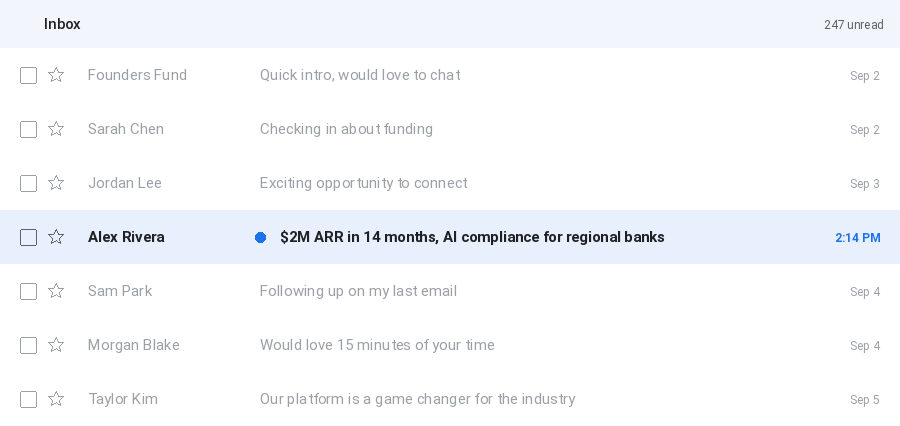
Your subject line functions as a headline rather than a greeting, and it decides whether an investor opens your message at all. Trace Cohen of Value Add VC points to a line like "$2M ARR in 14 months, AI compliance for regional banks" as far more effective than something generic like "Exciting opportunity to connect," since the specific version puts your strongest fact directly in front of the reader.
Allie Janoch, CEO of Mapistry, rewrote her subject line for hours before sending the email that helped close her $2.5 million seed round, naming what her company does, referencing her most impressive customer, and stating the round type in a single line.
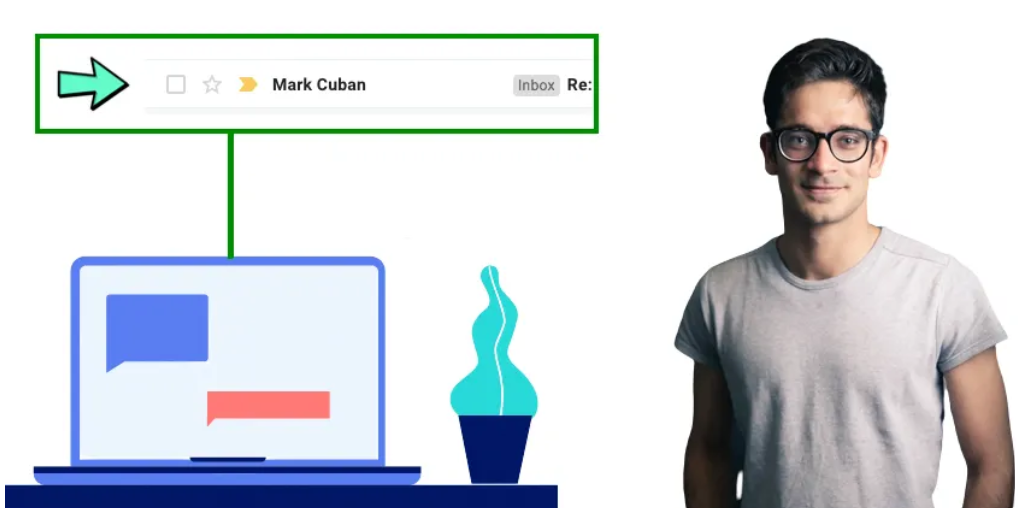
Dhruv Ghulati of Factmata wrote a plainer subject line when he emailed Mark Cuban, using only "Reaching out, Factmata" and placing his credibility signal in the opening line of the email body instead. Cuban replied to that email on the same day it landed in his inbox.
How Should You Structure The Body Of Your Investor Email?
Your opening sentence carries the entire weight of getting read further, since it needs to state clearly what your company does in plain language, with no jargon anywhere in it. Michael Seibel, Group Partner and Managing Director at Y Combinator, advises founders to write that sentence assuming the reader has limited attention available, which makes clarity your only real priority in that opening line.
His own worked example opens with "My name is Tim and I'm building Twitch for cooking," locating the company instantly inside a category the reader already understands.
Deciding how directly to make your ask matters just as much as your opening line, and investors hold genuinely different views on this point. Seibel advises against asking for a call or a meeting directly, preferring that founders state what they want (advice, investment, or an introduction) and let the investor decide how to respond.
Allie Janoch's winning email to Jason Lemkin closed with a direct ask for a 30-minute call the following week, and he accepted within hours of receiving it. Picking one approach deliberately, matched to what you know about the specific investor's style, matters more than which approach you choose.
What Changed Between A Failed Investor Email And A Funded One?
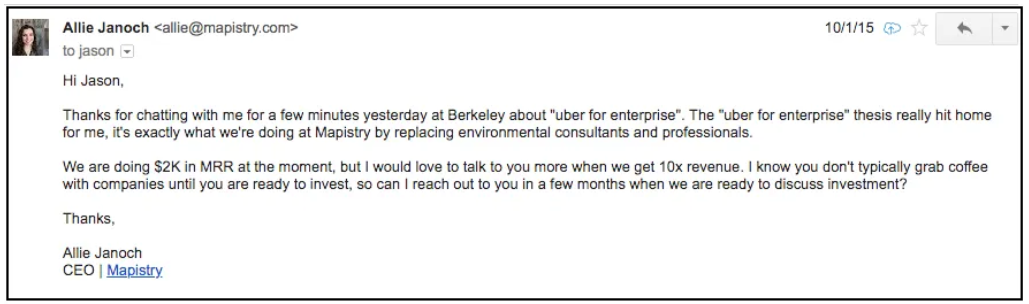
Allie Janoch's first attempt at reaching her eventual investor went unanswered two years before her successful round closed. She later described that email honestly: it never explained what Mapistry actually does beyond a vague allusion, and it closed with an ask ("can I reach out to you in a few months") that gave the reader nothing concrete to respond to.
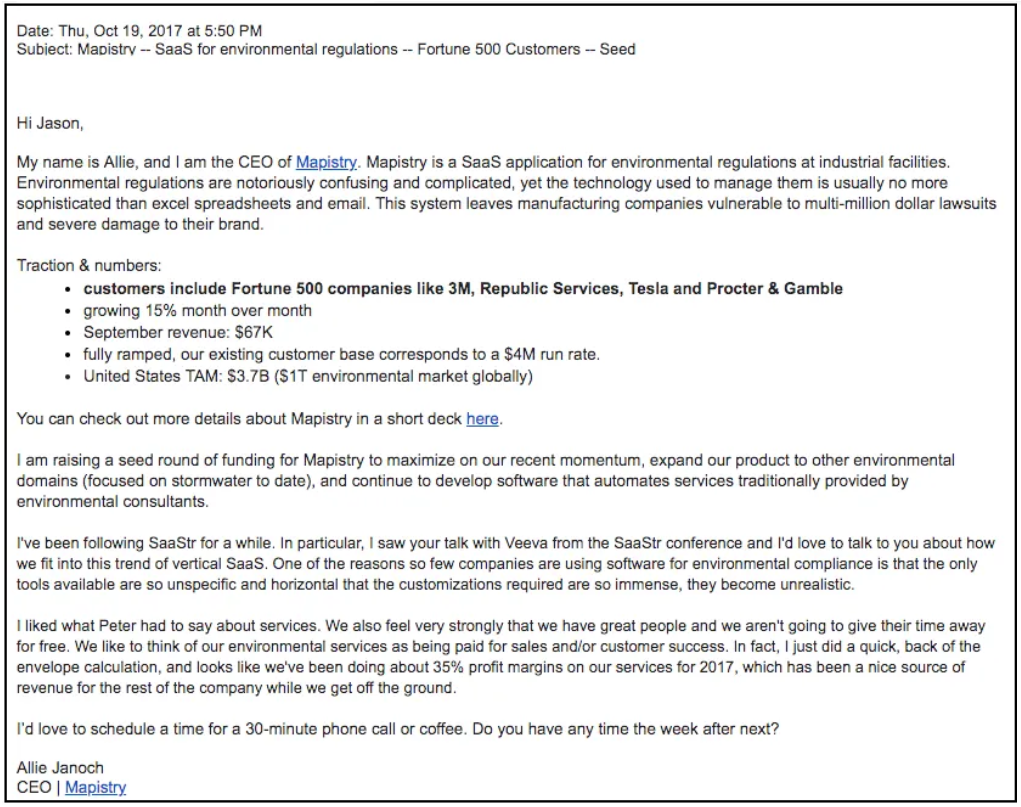
Her second attempt at the same investor added a clear explanation of the business, bolded proof points, specific research on his published work, and a direct ask for a meeting. That version got a reply within hours, and nothing about her company or her background had changed between the two emails except the structure she used to present them.
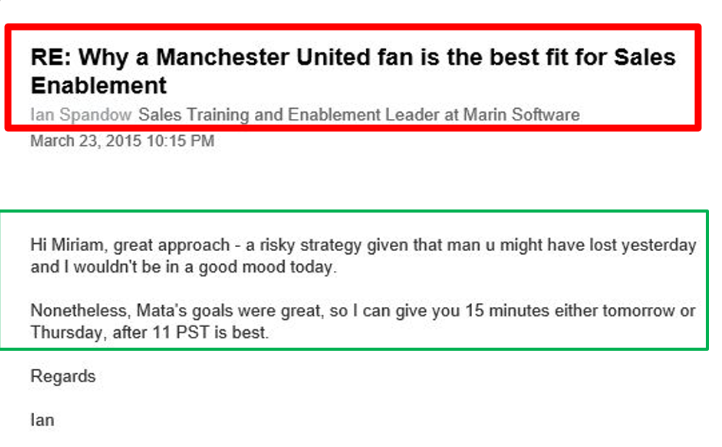
Suvikas Bhandari, GTM Operator at nRev, watched a nearly identical pattern play out at a sales training company he worked at earlier in his career. Thirty-five formal, feature-led emails to enterprise buyers produced zero replies.
The team then started referencing something genuinely personal about each recipient, a cycling hobby or a favorite football team, directly in the subject line and opening sentence. That shift produced sixty-five personalized emails and five booked product demos from the same target list.
Why Do 70% Of Investor Emails Fail On Basic Research Alone?
Generic flattery reads as filler to an investor, since nearly every founder writes some version of "I love what you're building" without adding anything specific behind it. Trace Cohen of Value Add VC calls this the most commonly missed step in the entire email, and he points to one sentence referencing a specific portfolio company, a blog post, or a publicly stated thesis as the thing that actually moves a reply.
Preeti Sampat, Partner at Eximius Ventures, confirms this gap from the receiving end of the inbox. More than 70% of the outreach she sees skips real research entirely, arriving from founders who glanced at a LinkedIn profile, looked at one or two portfolio companies, and ran a generic summary through ChatGPT instead of doing the actual homework.
Allie Janoch spent hours before emailing Jason Lemkin re-reading his published content and found a specific interview referencing Peter Gassner, CEO of Veeva, that let her connect her own company's contrarian revenue model to a point Lemkin had made publicly himself. Lemkin later named that same email among a short list of cold emails he personally funded, and the company behind it, Talkdesk, was worth roughly $1 million in annual revenue at the time and is valued above $3 billion today.
What's The Ideal Word Count For A Cold Investor Email?
Sources vary somewhat on exact word count, with some suggesting roughly 50 to 75 words and others allowing up to 150, though they converge on the same underlying idea. Michael Seibel of Y Combinator lists writing too much as one of the most common mistakes he sees, since long blocks of text consistently produce slower replies or none at all.
Allie Janoch's winning email used short paragraphs, bolding, and bullet points to cover what her company does, its traction, its market, and a personal note, without ever reading like a wall of text to the investor receiving it.
Attachments follow a similar logic of deliberate choice rather than default habit. Trace Cohen advises attaching nothing at all, letting the email earn a meeting and the meeting earn the deck, while Janoch's email included her deck directly, reasoning that a prepared investor might want that context immediately. Both approaches have produced funded rounds for the founders who used them.
How Many Times Should You Follow Up With An Investor?
Dhruv Ghulati's first email to Mark Cuban got a fast reply and a request for his deck, then went quiet for several days. He sent one follow-up, referencing Cuban's own public views on the exact problem Factmata was solving. That single message restarted the conversation, and after six total emails, Cuban offered $250,000 immediately, with another $250,000 to follow six months later.
Trace Cohen of Value Add VC recommends exactly one follow-up, sent roughly a week later, carrying a genuinely new piece of information rather than a repeat of the original ask. He personally responds to about 3 of the 50 cold emails he receives weekly, and successful follow-ups consistently carry new data.
Two unanswered follow-ups signal that the answer is no, according to Cohen, who advises moving on at that point. The venture community stays small enough that a reputation for respecting people's time compounds over a career.
Pull up the last cold email you sent to an investor and hold it against every choice covered here: your targeting, your subject line, your opening sentence, your research, your length, and your follow-up plan.
Allie Janoch, Suvikas Bhandari, and Dhruv Ghulati all rewrote a failed email using exactly this structure, and each rewrite closed with a funded outcome. The structure works because founders applied it deliberately, one decision at a time, rather than treating it as a script to copy.
If you're scaling a B2B startup, GTMX Ventures helps founders with go-to-market and fundraising. Feel free to reach out.
Saurabh Lahoti
Saurabh Lahoti is the founder of GTMDialogues, helping early-stage B2B startups scale with sharper GTM strategy, inbound marketing, and founder-led storytelling.






.png)

.png)

.png)

.png)


.png)


.png)
