What It Actually Takes to Scale From $0 to $1M ARR in 2026
Aug 11
•
8
min read
0 to 1 Stage
Saurabh Lahoti
Saurabh Lahoti is the founder of GTMDialogues, helping early-stage B2B startups scale with sharper GTM strategy, inbound marketing, and founder-led storytelling.
Six weeks. That's all the time Trellis needed to go from zero to $614,000 in annual recurring revenue. They grew 15% week on week through June, the peak period when property managers tell every new vendor to call back in October.
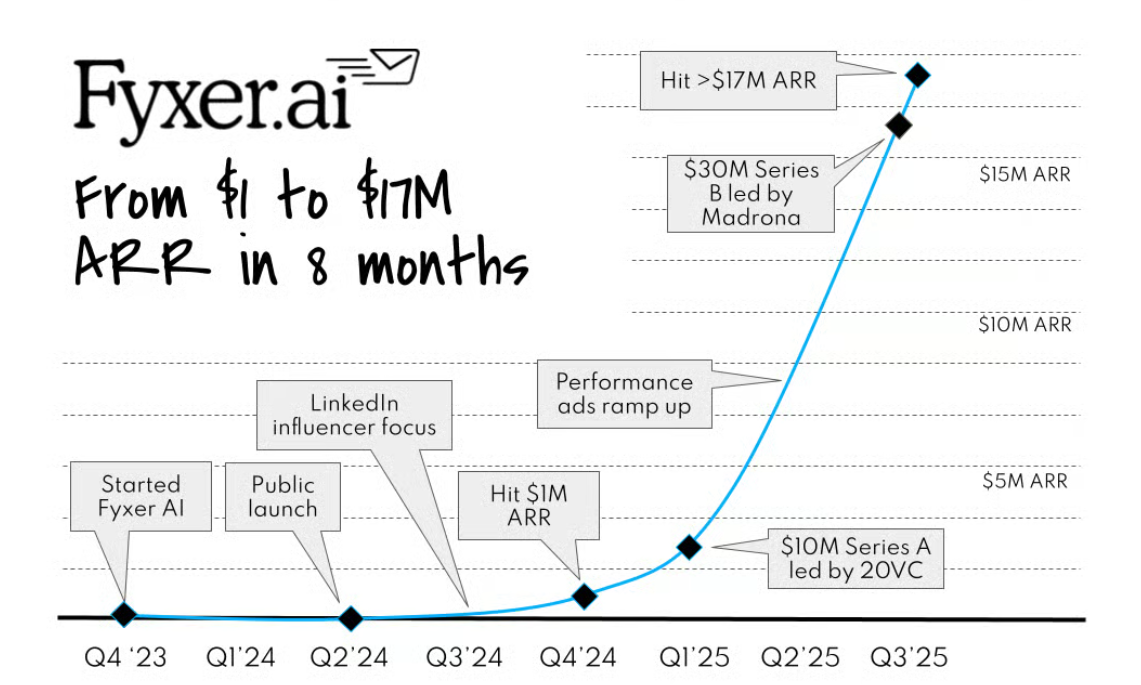
bolt.new crossed $4 million ARR in four weeks. GrowthX started building in October 2024 and hit $12 million ARR twelve months later. Fyxer went from $1 million to $17 million ARR in eight months. Harvey reached $200 million ARR in thirty-six months and is now tracking toward $300 million by mid-2026.
At Y Combinator's Winter 2026 Demo Day, fourteen startups had already crossed $1 million ARR before the event began, the highest number in YC's twenty-year history.
What's driving this comes down to six deliberate decisions: how founders sell before anyone else does, who they choose to sell to, how their product is built for distribution, how they price it, what they measure, and how they know when speed itself becomes the risk.
This piece breaks each one down with documented examples from companies that have already made this run, so you can identify where your startup stands and what to act on first.
Can Your First Twenty Deals be the Foundation of Every Sale That Follows
Before your team, your channel strategy, or your sales process exists, selling is your job.
Bessemer Venture Partners, in their founder playbook for scaling to $1 million ARR, make a point of this: founder-led sales should land the first dozen customers, and a meaningful share of those should come from cold outreach. The reason is that a warm introduction gets you a meeting and a cold close tells you whether the product earns its place without anyone vouching for it first.
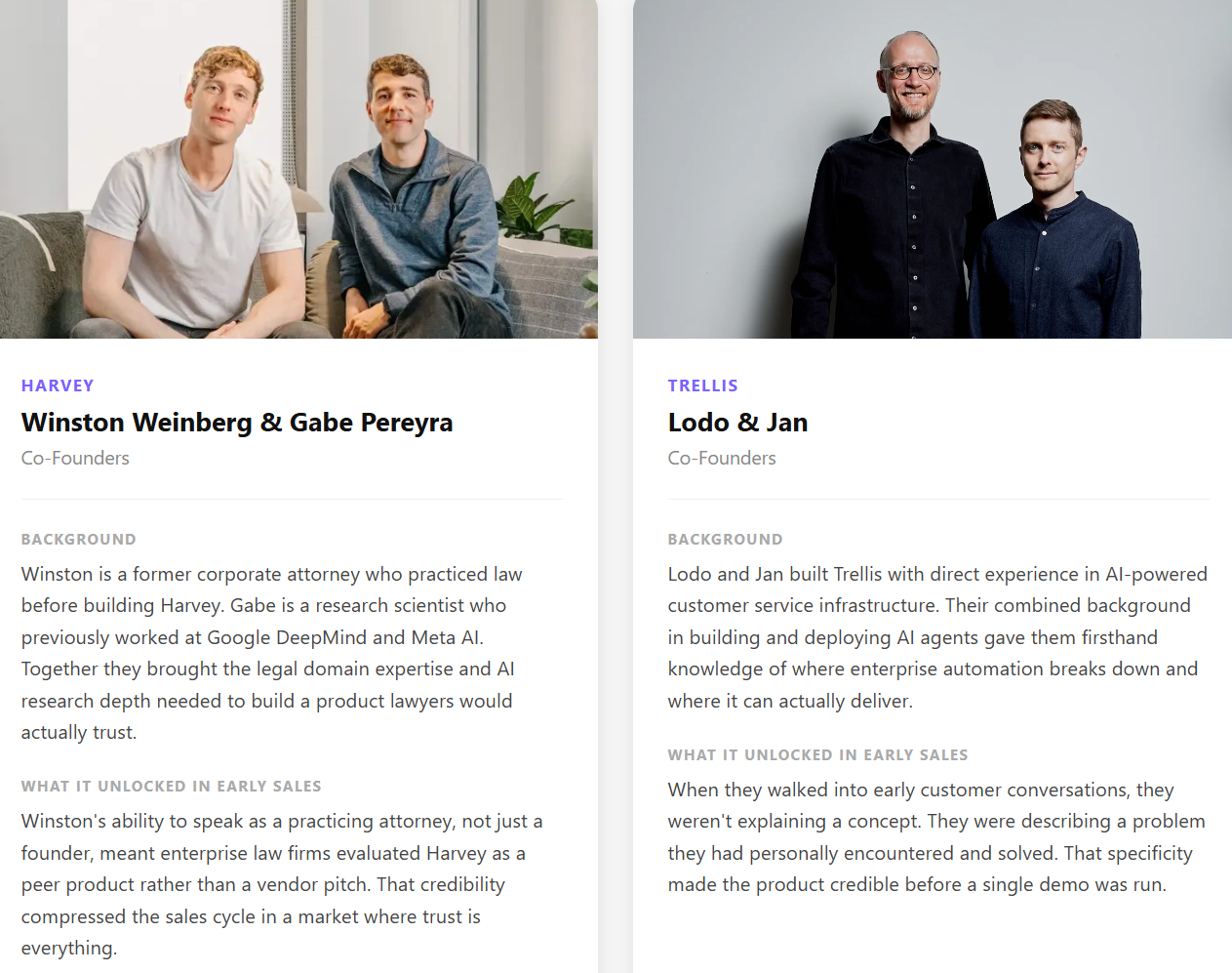
The founders of Trellis brought the same quality of knowledge to their first sales conversations. Lodo, one of the co-founders, had previously built AI customer service agents for short-term rental operators at Conduit (YC W24) and had personally scaled a property management company to over 150 listings and $2 million in revenue.
His co-founder Jan had spent years speaking directly with thousands of property managers through consulting and media work in the same industry. When they launched Trellis, they already knew which problems kept their buyers up at night, how operators talked about those problems, and what a solution needed to look like to be taken seriously.
That knowledge is what turns your early selling experience into a playbook that someone else can eventually follow.
How Does the Customer You Choose Today Compound Into the Business You Build Tomorrow?
When founders keep their ICP broad, they spread their early signal across too many segments and never go deep enough into any one of them to know whether the product is working.
Bessemer's founder playbook describes the right ICP as "uncomfortably narrow." The word uncomfortable is intentional. If your target customer definition doesn't make someone push back and ask whether you're going after too small a market, you haven't gone narrow enough yet.
Archie and Richard, the co-founders of Fyxer, an AI email assistant built to simplify workplace communication, spent six years across three failed products before they found their footing. When they launched Fyxer, they built it specifically for professionals outside of tech who needed help managing communication without a learning curve — a deliberately narrow group that most software companies overlook in favour of tech-savvy early adopters.
That specificity created a distribution pattern they hadn't fully planned for. When one person inside an organisation started using Fyxer, it spread laterally to their team, with each individual user becoming an internal channel. A $50 credit for every teammate referred accelerated that spread, and the company went from $1 million to $17 million ARR in eight months because the ICP choice created a natural expansion loop inside organisations.
GrazeMate, a startup that builds autonomous drones to herd cattle and monitor livestock, took vertical specificity even further. At YC's Winter 2026 Demo Day, they stood out not because of a broad agriculture thesis but because of how precisely they had defined their customer. They targeted large-scale cattle ranchers specifically, operators who spend anywhere from $10,000 to $1 million per year moving cattle between fields using labour, helicopters, and time. GrazeMate currently has 1.7 million acres under contract, and that number exists because every customer they signed was exactly the right one.
If you removed your product's name from your pitch and showed it to ten people in your target segment, would they immediately recognise it as built for them? If there's any hesitation in that answer, the ICP needs to get narrower.
How Three Fast-Scaling Companies Turned Their Product Into Their Biggest Distribution Channel
Most founders treat product architecture as an engineering decision, but the fastest-scaling AI companies treat it as a growth decision made before the first line of code is written. The distinction is whether your product, by its nature, brings in the next customer every time the current one uses it.
This is about building distribution into the core of what the product does, so that usage and acquisition become the same motion.
How Gamma Turned Every Shared Deck Into a New Customer
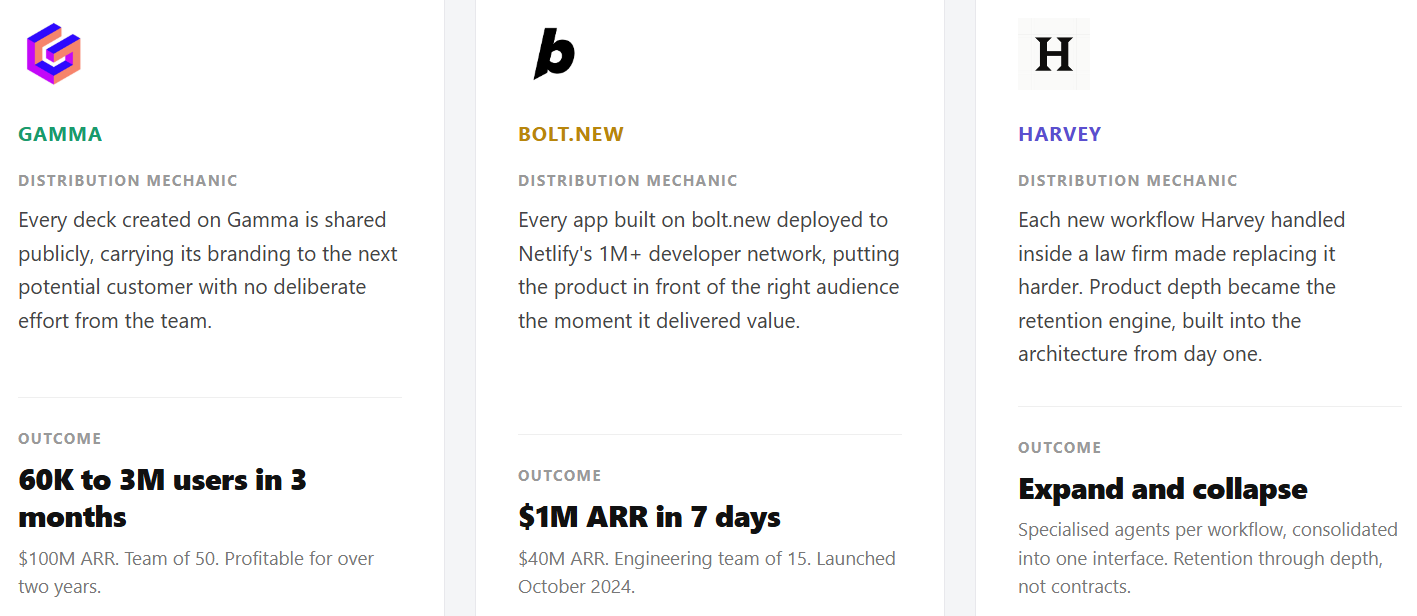
Gamma builds AI-powered presentations, documents, and websites, and from the beginning, every piece of content created on the platform was designed to be shared publicly. Every shared piece carried Gamma's branding into the next viewer's screen, which meant that each user who created something was also introducing the product to the next potential customer without any deliberate effort on Gamma's part.
When Gamma integrated AI to solve what they called the "blank page problem," removing the friction of starting a presentation from scratch, activation rates went from a 95% drop-off to a 50x explosion in users, taking them from 60,000 to 3 million users in three months. With 70 million users today, each one creating content that reaches a new audience, the architecture decision to make every output shareable became the engine behind the growth. Gamma reached $100 million ARR with a team of 50 people and has been profitable for over two years.
How bolt.new Turned Its First Technical Integration Into Its Biggest Distribution Channel
When bolt.new launched in October 2024, the product let users describe an app in text and watch it get built and deployed in sixty seconds. On day one, the team integrated with Netlify, a platform already used by over a million developers, so that every app a user built went live on a network where the right audience was already present.
When those developers started noticing bolt.new apps appearing on Netlify, the product was already in front of them at the exact moment it delivered value. bolt.new added $60,000 in ARR on its launch day, crossed $1 million in ARR within seven days, and reached $40 million in ARR with an engineering team of fifteen people. The Netlify integration was an architectural decision made before launch, and it became the distribution engine that made those numbers possible.
How Harvey Made Its Product Harder to Replace With Every New Workflow It Handled
Harvey, the AI platform built for legal professionals, took a different path to product stickiness. Their approach, which they describe as "expand and collapse," involved building specialised AI agents for specific legal workflows including drafting, research, and due diligence, and then consolidating them into a single interface that routes each user to the right agent based on what they need.
As law firms adopted Harvey and the number of workflows it handled inside each firm grew, replacing it with a single-workflow competitor became increasingly difficult. The product's depth of integration into daily legal work became the reason clients stayed, and that outcome was built into the architecture from the beginning rather than engineered through contracts or habit.
The question worth bringing to your own product is whether a user who stopped seeing your marketing would still find you through the actions of someone who already uses it. If that pathway doesn't exist, the architecture is solving for the product experience while leaving the distribution question unanswered.
Why the Founders Who Tested Their Price Before Scaling Built More Defensible Businesses
Most early-stage founders price their product by looking at what comparable tools in their category charge and picking a number close to that. Pricing this way means you're anchoring to what came before, not to the value your product is actually delivering.
Inheriting the category price without testing what customers would pay for an AI-powered outcome.
Discounting to close, which signals the price was never validated in the first place.
Flat pricing on variable cost, which compresses your margin the moment your product starts working.
Bessemer's founder playbook puts it simply: by $500,000 in ARR, your pricing should close without a founder discount. If it doesn't, the price hasn't been tested.
When Gamma was building in a presentation software category where $10 per month was considered a reasonable price, they tested what customers would actually pay for an AI-powered experience rather than assuming the category ceiling was fixed. What they found was a willingness to pay at $20 per month, a number the category had never validated before. The moves that got them there were straightforward:
Testing price points above the category norm before assuming the ceiling was fixed
Tiering the product so different segments paid for different depths of access
Building a free plan that drove activation and let paid tiers sell themselves through demonstrated value
Gamma reached $100 million ARR and a $2.1 billion valuation, with their Pro plan sitting at $20 per user per month.
Fin, the AI customer support agent built by Intercom, approached pricing from a different angle entirely. Rather than charging per seat, Fin charges $0.99 per resolved conversation, meaning customers pay when their problem is actually solved.
That shift changed the sales conversation from justifying a software cost to comparing $0.99 against what the buyer was already spending per human-handled support ticket. By June 2026, when Salesforce agreed to acquire Fin for approximately $3.6 billion, the product had resolved over 40 million customer conversations under that structure. The outcome-based model worked because it aligned three things at once:
What the customer pays with what the product actually delivers
The sales conversation with a number the buyer already tracks
Revenue growth with product performance, so as the product improves, the pricing case strengthens
The founders who scaled fastest tested what customers would pay for the outcome the product delivered, found the real number, and built their economics around it.
Why the Metrics You Track at Early-Stage Determine the Direction Your Business Grows In
Most early-stage teams inherit their measurement framework from traditional SaaS playbooks: monthly recurring revenue, churn rate, customer acquisition cost, and lifetime value. These numbers become meaningful at scale. At the zero-to-$1 million stage, you need the numbers that tell you what is about to happen, not what already did.
Kyle Poyar, who interviewed founders from over a dozen breakout AI-native companies for Growth Unhinged, found one consistent pattern: "PMF was often so obvious that it was inarguable. Founders either felt extreme market pull or they didn't." If you are still building an internal case for why the product is working, that is a signal worth paying attention to.
The leading indicators worth tracking at this stage are:
Trial-to-paid conversion rate. This tells you whether your product delivers enough value within the trial window for a buyer to commit without being pushed. A strong conversion rate at this stage sits above 60%, and anything below that usually points to onboarding that isn't reaching the right moment fast enough.
Week-on-week revenue growth. At this stage, a month is too wide a window to catch problems early enough to act on them. The fastest YC W26 companies averaged 14% week-on-week growth, and if your number starts compressing, you want to know in week three.
Time-to-value. This is the gap between when a user signs up and when the product first does something that makes them want to stay. Map the exact step where converting users first experience that moment and redesign your onboarding to compress that window.
Week 1 and Week 4 retention. Week 1 tells you whether onboarding delivers value before the user loses momentum. Week 4 tells you whether the product has built enough of a habit that the user is still there a month in.
Fyxer, the AI email assistant that grew from $1 million to $35 million ARR, built a company-wide infrastructure around these signals. In twelve months, the team ran 541 A/B tests, more than two per working day, with a growth engineering team of four people led by Kameron Tanseli accounting for 360 of those experiments. Every result was shared in a public Slack channel visible to the entire company, making measurement a shared discipline rather than a function owned by one team.
Trellis shows what those indicators look like when the machine is working. When they hit $614,000 in ARR in six weeks, the signals that preceded it were 100% trial-to-paid conversion and 15% week-on-week revenue growth. Both numbers were measurable and healthy before the ARR crossed any significant threshold, which meant the team knew the product was working before the market made it obvious.
The goal is to identify the two or three numbers that are leading your growth and track them with enough frequency to know when they change before your revenue does.
Why the Customers You Scale With Matter as Much as the Speed You Scale At
When week-on-week numbers are moving, it becomes easy to assume that what's growing is the right thing. The fastest-scaling companies in this piece all had clarity on that question before they accelerated, and that clarity is what made the speed sustainable.
Before you treat hyperscale as the objective, hold your current growth against these specific risks:
Growing into the wrong ICP. If your early customers came through warm intros, goodwill, or a discounted close, you may have signed people who represent a different buyer than the one your product is built for. Scaling acquisition on top of that means your next hundred customers look like your first ten, and your first ten were the wrong ones.
Acquisition without retention. Week-on-week revenue growth is a leading indicator only if the customers generating it stay. If your week 4 retention is weak and you're still scaling acquisition, new revenue is being offset by customers leaving faster than you're replacing them.
Commercial traction outpacing technical readiness. This risk applies to any product where the core proof point hasn't been validated in the environment that actually matters.
Beyond Reach Labs, a space technology startup that builds solar arrays which launch the size of a dining table and unfold to the size of a football field in orbit, is a clear example of that third risk playing out at scale. At YC's Winter 2026 Demo Day, the company had already secured over $175 million in letters of intent from leading space companies, ahead of its first in-space demonstration flight scheduled for Q2 2027.
The LOI volume signals genuine commercial interest from serious buyers. It also means those buyers are holding significant financial commitments while waiting on a proof point that hasn't happened yet. Space behaves differently than any ground simulation: vibration, vacuum, extreme temperature swings, and zero gravity cannot be fully replicated in a lab. The demo flight is where the product proves itself in the one environment that matters, and the entire commercial case depends on that outcome.
The question worth bringing to your own business is whether the growth you're seeing reflects validated proof or market enthusiasm that has moved ahead of it.
The results across every company in this piece came from decisions stacked across all six areas at once: founder-led selling, a narrow customer choice, a product built for distribution, tested pricing, the right leading indicators, and an honest read on whether the speed was healthy. Find the area where your startup is weakest right now and start there.
The six areas covered in this article are drawn from theGTMX Ventures Hyperscale Playbook. Download the full whitepaper for deeper frameworks, sourced examples, and the decision points that matter most at each stage.
Frequently Asked Questions
Does this playbook only apply to AI startups?
The six factors apply to any early-stage B2B company. What's specific to AI is the speed, the median AI-native startup now reaches $1 million ARR twelve months after starting to build. Outside of AI, the same playbook holds and the timelines reflect your category's pace.
What if your founding team has no domain expertise in the industry you're selling into?
The substitute for domain expertise is speed of learning. Run your first twenty sales conversations yourself, without a deck, and listen more than you pitch. What you hear is what years of industry experience would have given you on day one.
When is the right time to hire your first salesperson?
When you have a repeatable close process that someone else can follow without you on the call. Bessemer's guidance puts this between $1 million and $3 million ARR. Before that, a sales hire is learning the product at the same time as learning to sell it.
How do you know when your ICP is narrow enough?
Describe your ideal customer to an investor and see if they push back by saying the market is too small. If no one pushes back, go narrower. GrazeMate targeted large-scale cattle ranchers specifically and now has 1.7 million acres under contract.
How do you tell the difference between real PMF and early traction?
Kyle Poyar put it directly: "PMF was often so obvious that it was inarguable." The signals are inbound demand you didn't generate, retention you didn't have to engineer, and customers who get visibly frustrated at the idea of losing access.
Should your price be based on what competitors charge or what your product is worth?
Founders inherit the price point of the tool they're replacing. If your product automates something that costs a buyer $50,000 a year, pricing at $99 per month means you're capturing less than 3% of the value you're delivering. Start from what the outcome is worth, then test from there.
Saurabh Lahoti
Saurabh Lahoti is the founder of GTMDialogues, helping early-stage B2B startups scale with sharper GTM strategy, inbound marketing, and founder-led storytelling.







.png)

.png)

.png)

.png)


.png)


.png)
